
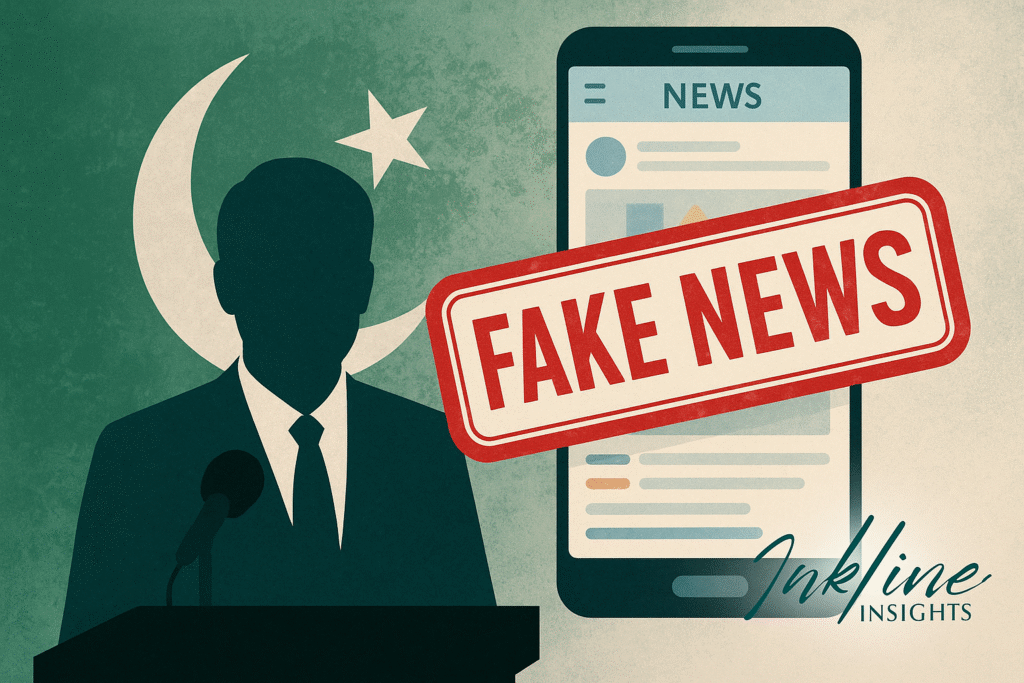
The Pakistani government has announced a renewed crackdown on the spread of fabricated news online after internal assessments suggested that “a significant majority” of viral social media content circulating during major political and security events contained misleading, exaggerated, or entirely false information. Officials involved in the review stated that widespread misinformation had contributed to public confusion, rapid shifts in online sentiment, and the amplification of emotionally charged narratives that often lacked credible sourcing. According to preliminary findings shared by authorities, false claims frequently originated from small clusters of accounts before being replicated across larger networks, where reposting patterns created the appearance of authenticity. Analysts also noted that manipulated videos, edited screenshots, and AI-generated content played an increasingly central role in shaping online discourse, with some fabricated posts gaining “hundreds of thousands of impressions within hours,” a scale that prompted concerns about the potential for real-world consequences.
Government representatives indicated that the new crackdown will include deeper collaboration with major platforms to request metadata on suspicious accounts, as well as measures to identify automated posting activity, coordinated networks, and monetized pages that profit from sensational misinformation. Officials emphasized that many misleading narratives spread through “emotion-driven phrasing” and leveraged trending hashtags to accelerate visibility, turning minor claims into high-traffic discussions. Cybercrime units have been instructed to map posting behaviours and trace linkages between repeat offenders, particularly those using anonymous profiles or foreign IP routing to obscure their identities. The interior ministry has also signalled its intention to tighten regulatory frameworks surrounding digital content, arguing that unchecked misinformation risks destabilizing public trust during sensitive national developments.
Digital rights advocates, meanwhile, have urged the government to maintain transparency in enforcement, cautioning that broad crackdowns could unintentionally restrict critical commentary or legitimate political speech if not overseen with clear safeguards. They highlighted that misinformation is a global challenge, often requiring educational and technological solutions rather than purely punitive measures. However, officials insist that the scale and speed of recent false information campaigns necessitate immediate intervention, describing the effort as essential for protecting “information integrity” in the country’s rapidly evolving online ecosystem. As platforms, policymakers, and civil society debate the balance between regulation and expression, the crackdown marks a pivotal moment in Pakistan’s attempt to manage the growing influence of digital narratives on public perception and national stability.