
Introduction
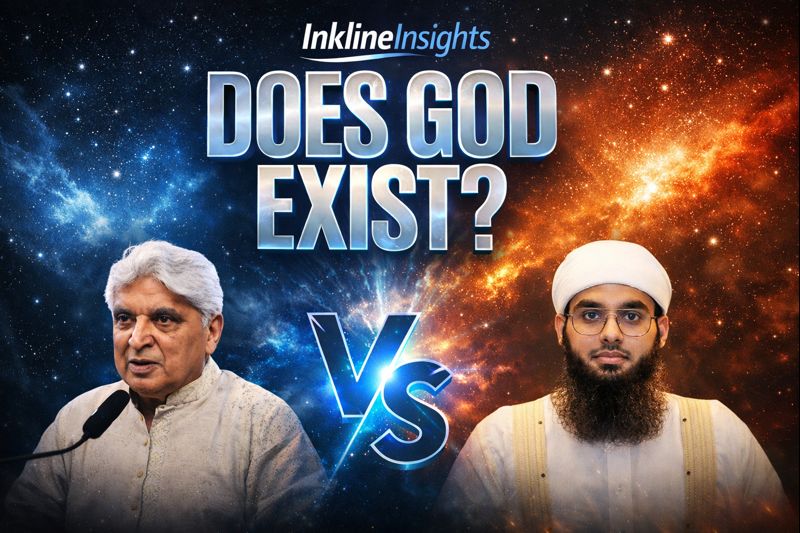
The debate on “Does God Exist?” featuring Mufti Shamail Nadwi and Javed Akhtar has become one of the most discussed intellectual exchanges in South Asia. The discussion attracted massive attention because it brought together two sharply contrasting worldviews: classical theism and modern atheistic rationalism.
The debate took place on 20 December 2025 at the Constitution Club of India in New Delhi.The discussion was moderated by journalist Saurabh Dwivedi, who is the editor of The Lallantop, guiding the structured dialogue between the participants.
Background of the Debate
- Mufti Shamail Nadwi is an Islamic scholar trained in theology, logic, and philosophy, particularly metaphysics and moral philosophy.
- Javed Akhtar is a renowned poet and lyricist who openly identifies as an atheist/agnostic, advocating skepticism and humanism.
The debate focused on:
- Existence of God
- Science vs metaphysics
- Morality and ethics
- Suffering and the problem of evil
Core Arguments Presented
1. Argument from Cause and Origin of the Universe
Mufti Shamail Nadwi’s Position
- The universe had a beginning, a fact supported by modern cosmology (Big Bang theory).
- Anything that begins to exist requires a cause.
- Therefore, the universe requires a necessary, uncaused cause, identified as God.
This argument aligns with well-established philosophical reasoning used by thinkers such as Aristotle and Ibn Sina.
Javed Akhtar’s Response
- He questioned why God should be exempt from causation.
- He rejected metaphysical explanations that cannot be empirically tested.
Analysis
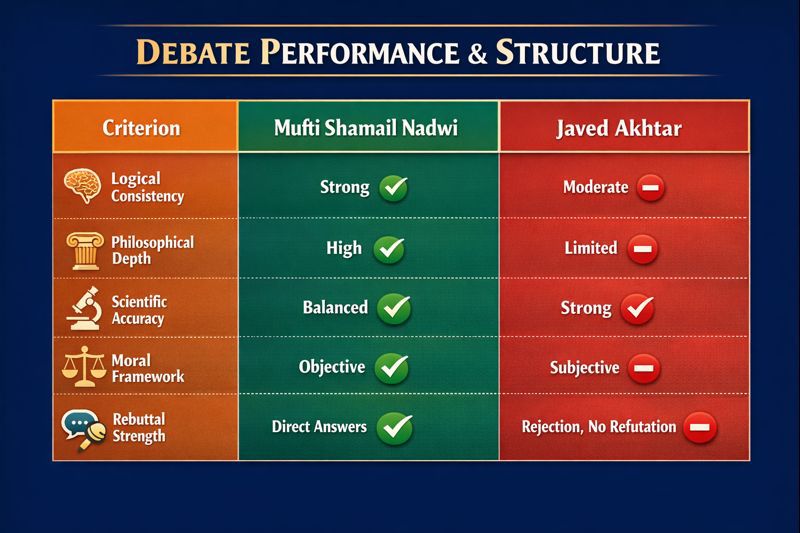
Akhtar challenged the premise emotionally but did not refute the necessary vs contingent existence distinction. Nadwi’s argument remained logically intact.
2. Science and the Limits of Empirical Evidence
Javed Akhtar’s Position
- Belief should be based only on what can be tested, measured, and verified.
- Science has progressively replaced supernatural explanations.
Mufti Shamail Nadwi’s Counter
- Science explains processes, not existence itself.
- Questions such as why there is something rather than nothing fall outside scientific measurement.
- Rejecting metaphysics is itself a philosophical stance, not a scientific one.
Fact Check
- Many foundational scientific concepts (laws of nature, logic, mathematics) are not physically observable, yet universally accepted.
3. Morality Without God
Javed Akhtar
- Morality can exist without God through empathy, social norms, and human consensus.
Mufti Shamail Nadwi
- Without God, morality becomes subjective and variable.
- History shows societies morally justified slavery, genocide, and oppression.
- Objective moral values require an objective moral source.
Logical Outcome
Akhtar did not provide a mechanism to explain why moral values should be universally binding without a higher authority. Nadwi’s position addressed this gap directly.
4. The Problem of Evil and Suffering
Atheist Argument
- If God exists and is merciful, why does suffering exist?
Theistic Response
- Without God, suffering is random and meaningless.
- With God, suffering can have purpose, accountability, and justice beyond material life.
- A temporary world cannot be used to judge an eternal framework.
Key Point
Akhtar highlighted emotional weight but offered no alternative explanation for meaning or justice in suffering.
Debate Performance and Structure
Audience and Intellectual Impact
- Religious and philosophy-oriented audiences found Nadwi’s arguments coherent and intellectually satisfying.
- Secular audiences resonated with Akhtar’s skepticism but noted the absence of alternative explanations.
- No argument from Akhtar decisively disproved theism; he maintained personal disbelief, not logical negation.
Key Insights
- God’s existence is a metaphysical question, not a laboratory experiment.
- Philosophy, not science alone, is the correct discipline for such debates.
- Denial of God requires as much philosophical justification as belief.
- Rational theism remains logically defensible in modern discourse.
Final Conclusion: Who Won the Debate?
Mufti Shamail Nadwi is the clear winner.
Why?
- He answered every objection within a coherent philosophical framework.
- His arguments were internally consistent, historically grounded, and logically valid.
- Javed Akhtar relied on skepticism and disbelief, not counter-proof.
- Rejecting an argument does not invalidate it unless it is logically disproven.
Final Verdict
Mufti Shamail Nadwi won the debate intellectually and philosophically, while Javed Akhtar remained unconvinced by choice, not by refutation.
Disclaimer
This article is informational and analytical, does not promote hate, coercion, or misinformation, and respects differing worldviews. All opinions are presented in a neutral, educational context.