
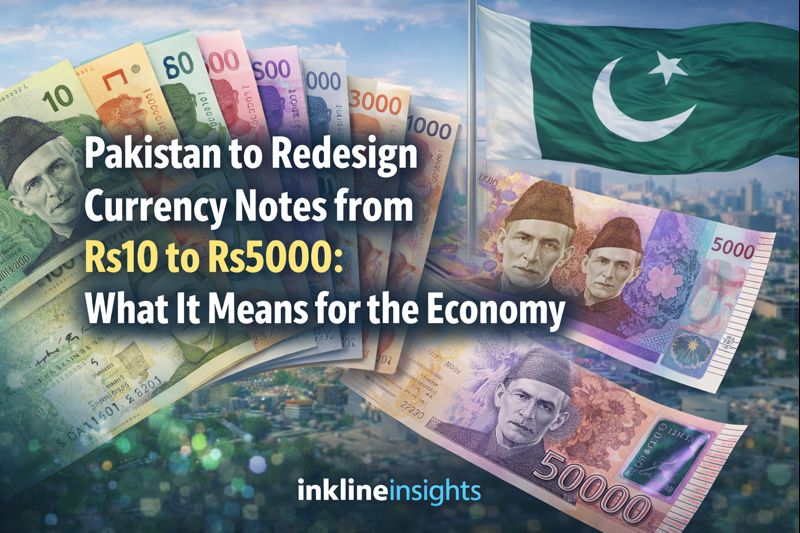
Pakistan is preparing for a major upgrade to its paper currency system, with reports indicating that all banknotes ranging from Rs10 to Rs5000 will gradually be redesigned. According to media reports, the move is aimed at improving security features, durability, and transparency in the financial system, while also aligning Pakistan’s currency with modern international standards.
One of the most talked-about aspects of this plan is the introduction of polymer (plastic) banknotes, a step that has already been adopted by several countries around the world. While the redesign will not change the value of money, it could have important implications for inflation control, counterfeit prevention, and daily cash usage.
WHY PAKISTAN IS REDESIGNING ITS CURRENCY NOTES
Currency redesigns are not unusual and are often driven by economic, security, and technological needs. Pakistan’s existing banknotes have been in circulation for many years, making them vulnerable to counterfeiting and rapid wear and tear.
According to banking experts, the key reasons behind this initiative include:
Rising counterfeit currency risks
High replacement costs of damaged paper notes
Need for modern security features
Improved public trust in cash transactions
The State Bank of Pakistan (SBP), which is responsible for issuing and regulating currency, periodically reviews banknote designs to ensure they remain secure and efficient.
FROM RS10 TO RS5000: NO DENOMINATION IS BEING DISCONTINUED
A common misconception spreading on social media is that certain denominations may be withdrawn. However, reports clarify that no denomination is being abolished. Instead, existing notes from Rs10 to Rs5000 will be gradually replaced with newly designed versions.
This means:
Old notes will remain legal tender
New notes will be introduced in phases
Both old and new notes may circulate together for some time
Such gradual replacement helps avoid public confusion and prevents disruption in markets and banking operations.
INTRODUCTION OF POLYMER (PLASTIC) NOTES IN PAKISTAN
One of the most significant developments under discussion is the introduction of polymer banknotes, commonly referred to as plastic notes.
WHAT ARE POLYMER NOTES?
Polymer notes are made from a special plastic material rather than traditional paper. Countries such as Australia, Canada, the UK, and New Zealand have already adopted polymer currency due to its multiple benefits.
BENEFITS OF POLYMER NOTES
Research shows that polymer notes offer several advantages:
Last up to 2.5 times longer than paper notes
More resistant to water, dirt, and tearing
Difficult to counterfeit
Lower long-term printing costs
Environmentally friendly due to longer lifespan
For Pakistan, where lower denomination notes like Rs10, Rs20, and Rs50 are frequently damaged, polymer notes could significantly reduce replacement expenses.
SECURITY FEATURES IN THE NEW CURRENCY DESIGN
Modern currency notes rely heavily on advanced security features to combat forgery. While final designs have not yet been officially released, experts expect the new Pakistani banknotes to include:
Enhanced watermarks
See-through windows (in polymer notes)
Color-shifting inks
Microtext and raised printing
Improved serial number tracking
These features help both banks and the general public easily identify genuine notes.
ECONOMIC IMPACT: WILL THIS AFFECT INFLATION?
A key concern among citizens is whether the new currency design could impact inflation or purchasing power. Economists clarify that changing the design or material of currency does not increase inflation by itself.
Inflation depends on factors such as:
Money supply
Fiscal policy
Fuel and food prices
Exchange rates
Since the value and denominations remain unchanged, this move is largely administrative and security-focused rather than monetary expansion.
WHAT THE PUBLIC NEEDS TO KNOW
For ordinary citizens, the transition is expected to be smooth. Here are some important points:
You do not need to exchange money immediately
Old notes will remain usable
Banks will guide customers if any exchange process is required
There is no deadline announced yet for withdrawing old designs
Authorities often run public awareness campaigns before fully implementing such changes to avoid panic or misinformation.
GLOBAL EXAMPLES PAKISTAN IS LEARNING FROM
Many countries have already shifted to polymer notes with positive results. For example:
Australia reduced counterfeiting significantly after introducing polymer notes
The UK increased durability and hygiene with polymer £5, £10, £20, and £50 notes
Canada reported long-term cost savings despite higher initial printing costs
Pakistan’s move appears aligned with these global best practices.
CHALLENGES AND IMPLEMENTATION TIMELINE
Despite its benefits, the transition will also face challenges, including:
Initial printing and machinery costs
ATM and vending machine compatibility
Public adaptation to new note textures
Experts believe the rollout will happen gradually over several years, starting with lower denominations.
FINAL THOUGHTS
The planned redesign of Pakistan’s currency notes from Rs10 to Rs5000, along with the possible introduction of polymer banknotes, marks a significant step toward modernizing the country’s financial system. While the change does not affect the value of money, it promises better security, durability, and long-term savings.
As with any major economic initiative, transparency and public awareness will be key to ensuring a smooth transition. Citizens are advised to rely on official announcements from the State Bank of Pakistan and avoid misinformation circulating on social media.