
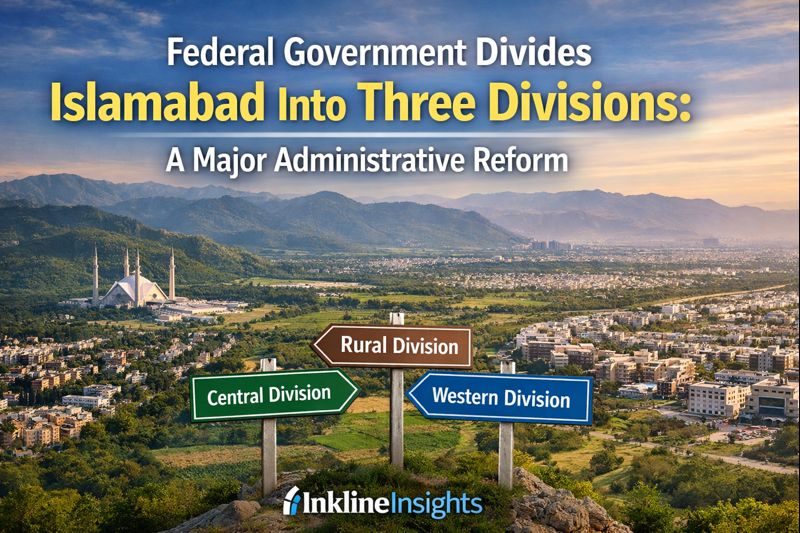
The federal government of Pakistan has reportedly decided to divide the Islamabad Capital Territory (ICT) into three administrative divisions, marking one of the most significant governance reforms in the capital’s history. This strategic move aims to improve service delivery, strengthen local administration, and manage Islamabad’s rapidly growing population more efficiently. As the capital city expands in size and complexity, the traditional single-administration model has faced increasing pressure, prompting authorities to consider a more decentralized system.
Islamabad, which was originally designed to accommodate around one million residents, now hosts an estimated 2.3 to 2.5 million people, according to population projections based on census growth trends. This rapid expansion has placed immense strain on civic services, infrastructure, law enforcement, and land management. The proposed division into three administrative units is expected to address these challenges in a structured and sustainable manner.
Why Islamabad Needs Administrative Division
Over the past two decades, Islamabad has experienced unprecedented urban growth. New housing societies, commercial zones, and suburban settlements have emerged far beyond the city’s original master plan. Managing such a vast and diverse territory under a single administrative setup has become increasingly difficult.
Currently, the Islamabad Capital Territory is governed by a centralized structure, where multiple departments report to a limited number of administrative heads. This often results in bureaucratic delays, overlapping responsibilities, and slow response times to public complaints. By dividing Islamabad into three divisions, the government aims to bring administration closer to the people and improve coordination among departments.
Decentralization has already proven successful in several provinces of Pakistan, where new divisions and districts have led to better governance, faster decision-making, and improved law and order.
Proposed Structure of the Three Divisions
Although final boundaries are subject to official notification, policy discussions suggest that Islamabad may be divided based on geographical location, population density, and administrative needs.
1. Central Islamabad Division
This division is expected to include the main urban sectors, such as residential zones, commercial centers, government offices, and diplomatic areas. Due to high population density and economic activity, this division would focus heavily on municipal services, traffic management, sanitation, and commercial regulation.
2. Eastern or Rural Islamabad Division
Large rural areas surrounding Islamabad, including villages and agricultural land, are likely to form a separate division. These regions have distinct administrative needs, such as land revenue management, rural development, and agricultural support. A dedicated division would help address long-standing issues related to land records, local infrastructure, and basic facilities.
3. Western or Peri-Urban Islamabad Division
This division may include newly developed housing societies and expanding suburban areas. With rapid construction and real estate activity, this region requires strict building regulations, environmental monitoring, and planned urban development.
Each division would operate under its own administrative leadership, potentially including commissioners and supporting officers, ensuring focused governance.
Expected Benefits of Dividing Islamabad
Improved Governance and Efficiency
Smaller administrative units allow officials to monitor issues more closely and respond faster. Citizens would no longer need to navigate complex bureaucratic layers for basic services.
Better Law and Order Management
Islamabad has witnessed a rise in traffic congestion and urban crime due to population growth. Separate divisions would allow more effective policing strategies tailored to local conditions.
Enhanced Urban Planning
With Islamabad expanding rapidly, urban planning has become a major concern. Divisional administration would help ensure controlled development, zoning enforcement, and environmental protection.
Faster Public Service Delivery
Services such as issuance of domicile certificates, land verification, municipal approvals, and complaint resolution are expected to become more accessible and time-efficient.
Economic and Development Impact
The administrative division of Islamabad is also expected to create new employment opportunities within the public sector. Additional administrative offices, support staff, and service units will be required for each division.
From an economic perspective, improved governance often leads to increased investor confidence. Real estate developers, businesses, and service providers benefit from clear regulations and faster approvals. This reform could boost Islamabad’s contribution to the national economy, particularly in the construction and services sectors.
Challenges and Concerns
While the decision carries many benefits, it also presents challenges that must be addressed carefully.
Administrative Costs
Setting up new divisions requires funding for offices, staff, infrastructure, and technology. Proper budget planning will be essential to ensure long-term sustainability.
Coordination Between Divisions
Without effective coordination mechanisms, multiple divisions could lead to jurisdictional conflicts. A strong central framework will be needed to maintain harmony.
Public Awareness and Transition
Residents must be informed about new administrative boundaries, offices, and procedures. A smooth transition plan will be critical to avoid confusion.
Comparison with Other Cities
Several major cities in Pakistan and other countries operate under multi-division or district-based systems. Cities like Lahore and Karachi have multiple administrative zones to manage large populations effectively. Internationally, capitals such as London and Ankara follow decentralized models that allow localized governance while maintaining federal oversight.
Islamabad’s proposed division aligns with these global best practices, suggesting that the reform is both timely and necessary.
Conclusion
The federal government’s decision to divide Islamabad into three divisions represents a forward-looking administrative reform aimed at improving governance, efficiency, and quality of life for residents. As the capital continues to grow beyond its original design, decentralization offers a practical solution to modern urban challenges.
If implemented with proper planning, transparency, and public engagement, this initiative could transform Islamabad into a more organized, responsive, and sustainable capital city. While challenges exist, the long-term benefits of improved service delivery, better urban planning, and stronger administration make this decision a significant milestone in Pakistan’s governance landscape.