

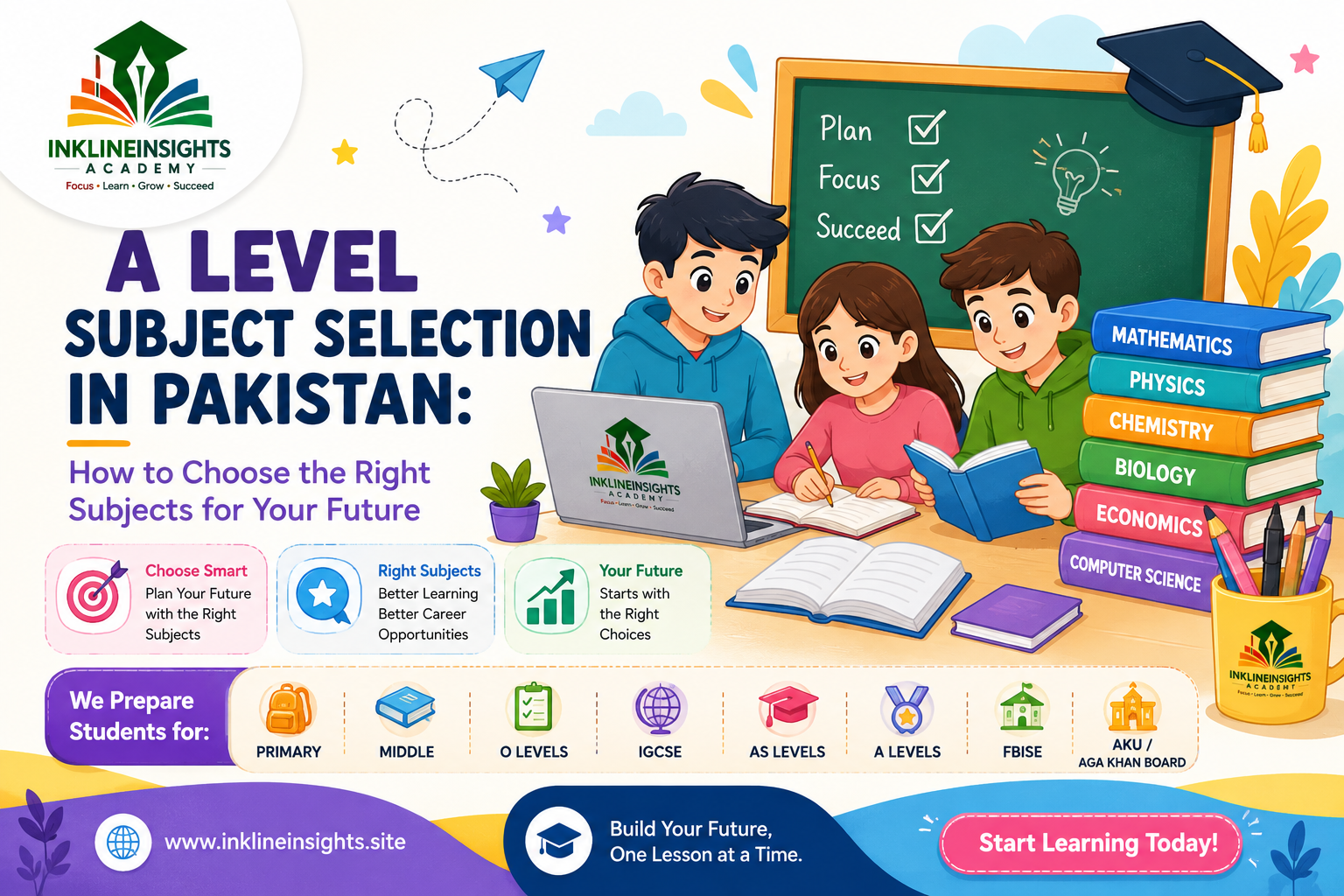
Choosing A Level subjects is one of the most important academic decisions students make after completing their O Levels or IGCSE. The subjects you choose can influence your university options, career direction, and overall academic experience.
For students in Pakistan following the Cambridge International pathway, understanding the difference between subjects and choosing combinations carefully can make the transition to A Levels much easier.
What Are A Levels?
Advanced Level, commonly known as A Level, is an internationally recognised qualification offered by Cambridge International and other examination boards.
A Levels allow students to study subjects in greater depth than at IGCSE or O Level. Instead of studying a large number of subjects, students normally select a smaller combination based on their interests, strengths, and future plans.
A Levels are commonly used as a pathway to universities in Pakistan and around the world.
How Many A Level Subjects Should You Choose?
The number of subjects depends on your academic plans, university requirements, and the policies of your school or college.
Many students choose three A Level subjects, while some may take four or another combination depending on their circumstances.
However, choosing more subjects does not automatically mean a better academic profile.
A balanced subject combination that you can perform well in is usually more valuable than taking too many difficult subjects and struggling to maintain strong grades.
How to Choose the Right A Level Subjects
Before making your final decision, consider the following factors.
1. Consider Your Future Career
Think about the field you may want to enter in the future.
For example:
Medicine:
Students commonly consider subjects such as Biology, Chemistry and Physics.
Engineering:
Mathematics and Physics are often important, with Chemistry or another relevant subject depending on the intended degree.
Computer Science:
Mathematics and Computer Science can be useful choices, although university requirements vary.
Business and Economics:
Economics, Business and Mathematics may be suitable depending on the university and degree.
Social Sciences:
Subjects such as Psychology, Sociology, Economics, History or other humanities subjects may be relevant depending on the intended degree.
The exact requirements can differ between universities, so students should always check the admission requirements of their preferred institutions before finalising their subjects.
2. Don’t Choose Subjects Only Because Your Friends Are Taking Them
One of the most common mistakes students make is selecting subjects simply because their friends are choosing them.
Your academic strengths may be completely different from those of your friends.
A subject that is easy for one student may be challenging for another.
Choose subjects according to your own interests, abilities and future goals.
3. Understand the Difference Between O Level and A Level
A Levels are significantly more advanced than O Levels and IGCSE.
Students should be prepared for:
- More detailed concepts
- Greater analytical thinking
- Longer and more complex questions
- Independent study
- Regular revision
- More demanding examination preparation
Good performance at O Level or IGCSE is a positive foundation, but students should not assume that A Levels will require exactly the same study approach.
4. Check University Requirements
Before choosing your subjects, research the universities and degree programmes you are considering.
Some degree programmes may require specific A Level subjects.
For example, a university may require particular science subjects for a medical programme or Mathematics for certain engineering and computing programmes.
Checking these requirements early can prevent problems later.
Students in Pakistan should also understand the relevant IBCC equivalence requirements when planning for local university admissions.
Popular A Level Subject Combinations
There is no single combination that is best for every student. However, some combinations are commonly selected.
Biology + Chemistry + Physics
This combination is often considered by students interested in medicine, healthcare and biological sciences.
Mathematics + Physics + Chemistry
This can be suitable for students interested in engineering and physical sciences, depending on university requirements.
Mathematics + Computer Science + Physics
This combination may appeal to students interested in computer science, software engineering, technology and related fields.
Mathematics + Economics + Business
This combination can be considered by students interested in business, economics, finance and management.
Economics + Business + Accounting
Students interested in business-related fields may consider this combination, depending on their future degree requirements.
The best combination is ultimately the one that matches your academic strengths and future plans.
Is A Level Difficult?
A Levels can be challenging, but difficulty does not mean that success is impossible.
The biggest difference is often the depth of learning required.
Students need to understand concepts rather than simply memorise information. They also need to develop examination techniques and learn how to apply their knowledge to unfamiliar questions.
Consistent preparation throughout the academic year can make a significant difference.
How Can Students Prepare for A Levels?
Students can make their A Level journey easier by developing good study habits from the beginning.
Study Consistently
Avoid relying entirely on last-minute preparation.
Studying smaller portions regularly is generally more manageable than trying to cover an entire syllabus shortly before examinations.
Practise Past Papers
Past papers are an important part of Cambridge examination preparation.
They help students become familiar with:
- Question styles
- Mark schemes
- Command words
- Time management
- Examination structure
Focus on Concepts
Understanding the concept behind a question is more useful than memorising an answer.
This is especially important in subjects such as Mathematics, Physics, Chemistry, Biology and Computer Science.
Ask for Help Early
If you do not understand a topic, don’t wait until examination season to address it.
Getting help early can prevent small gaps in understanding from becoming larger problems later.
A Level Preparation at Inklineinsights Academy
At Inklineinsights Academy, students can receive academic support for Cambridge pathways including A Level, AS Level, IGCSE and O Level, along with preparation for Aga Khan (AKU) and FBISE examinations.
Our focus is on building strong concepts, improving examination technique and helping students prepare consistently throughout the academic year.
Whether a student needs support with Mathematics, Physics, Chemistry, Biology, Computer Science or other subjects, structured academic guidance can help make the A Level journey more manageable.
Final Thoughts
Choosing A Level subjects is not simply about selecting the subjects that seem easiest or most popular.
It is about finding the right balance between your interests, academic strengths, university requirements and future career goals.
Take time to research your options, speak with teachers or academic advisers, and check the requirements of the universities you may want to attend.
With the right subject combination and consistent preparation, A Levels can provide a strong foundation for your future academic and professional journey.
Frequently Asked Questions
Which A Level subjects are best for students in Pakistan?
There is no single best combination. The right subjects depend on your intended university degree, career goals, academic strengths and university admission requirements.
How many A Level subjects should I take?
Many students take three A Level subjects, although the appropriate number depends on your school, university plans and individual circumstances.
Are A Levels difficult?
A Levels are academically demanding because they require greater depth, analysis and independent study than O Levels or IGCSE. Consistent preparation can make them much more manageable.
Can I change my A Level subjects later?
This depends on your school or college and how far you have progressed in the course. It is better to research your options carefully before making your final selection.
Are A Levels recognised by Pakistani universities?
Cambridge qualifications are widely recognised, but students applying to Pakistani universities should check the specific admission and equivalence requirements applicable to their chosen programme.

Leave a Reply