Higher education has long played a central role in career development. For generations, earning a university degree has been seen as a reliable path toward professional stability and personal growth.
However, the rapid advancement of artificial intelligence (AI) is reshaping how skills are learned, evaluated, and applied in the workforce. As a result, many educators, employers, and students are beginning to question whether traditional degree programs are keeping pace with modern demands.
This article explores how AI is influencing higher education, which types of degrees face the most disruption, and how universities and learners can adapt constructively.
The Traditional Role of University Degrees
Universities have historically provided:
- Structured learning environments
- Foundational theoretical knowledge
- Recognized credentials for employers
- Access to research, mentorship, and networks
These functions remain valuable. However, the economic and technological environment in which degrees operate has changed significantly.
AI tools can now perform tasks that once required years of formal education, particularly in information-heavy fields.
How AI Is Transforming Skill Acquisition
One of AI’s most significant impacts is its ability to accelerate learning.
Modern AI systems can:
- Explain complex concepts on demand
- Provide instant feedback
- Generate practice scenarios
- Assist with problem-solving in real time
This reduces the time required to acquire certain practical skills, especially in digital and analytical domains.
Example: Learning Data Analysis
Previously, learners relied heavily on textbooks, lectures, and expensive software. Today, AI-powered tools can guide users through real datasets, suggest improvements, and simulate business problems, allowing faster and more applied learning.
Case Study 1: Computer Science Education and Industry Expectations
Computer science remains a valuable field, but employers increasingly emphasize practical experience alongside formal education.
Many hiring teams now look for:
- Project portfolios
- Real-world applications
- Experience working with modern tools and frameworks
Graduates who combine a degree with hands-on projects and AI-assisted development often perform better in job markets than those relying solely on academic credentials.
This shift highlights the growing importance of applied learning rather than replacing formal education altogether.
Case Study 2: Business Education in an AI-Driven Economy
Business degrees traditionally focus on strategy, management theory, and case-based learning. While these foundations are important, AI has introduced new operational realities.
Modern businesses use AI for:
- Market analysis
- Financial forecasting
- Customer engagement
- Process automation
Professionals who understand how to integrate AI tools into business operations gain a competitive advantage, regardless of whether their knowledge was acquired through formal education, professional training, or self-directed learning.
Degrees Facing Greater Pressure to Adapt
AI’s impact is not uniform across all disciplines.
Fields Experiencing Faster Change:
- General business studies
- Marketing and communications
- Information technology
- Administrative and clerical disciplines
These areas rely heavily on information processing, which AI systems perform efficiently. This does not eliminate the need for human professionals but increases the importance of specialization and adaptability.
Fields That Remain Strongly Degree-Dependent
Many professions still require extensive formal education, certification, and regulation, including:
- Medicine
- Law
- Engineering
- Architecture
- Scientific research
In these areas, universities provide critical training, ethical frameworks, and supervised practice that AI cannot replace.
Curriculum Update Challenges in Higher Education
One of the primary challenges universities face is pace.
AI technologies evolve rapidly, while academic curricula often require years to update due to accreditation and governance processes. This can lead to gaps between what students learn and what employers expect.
Institutions that integrate:
- Project-based learning
- Industry collaboration
- AI literacy across disciplines
are better positioned to remain relevant.
The Growing Importance of Demonstrated Skills
Across many industries, employers increasingly value:
- Evidence of problem-solving ability
- Practical experience
- Continuous learning habits
Degrees are still respected, but they are often evaluated alongside portfolios, certifications, and work samples.
This reflects a broader shift toward skills-based hiring, rather than a rejection of higher education.
Education Is Evolving, Not Disappearing
AI is not replacing education. Instead, it is reshaping how knowledge is delivered and assessed.
The future of higher education likely includes:
- Hybrid learning models
- Shorter, modular programs
- Stronger links between theory and application
- Ongoing professional upskilling
Universities that embrace these changes can continue to provide significant value.
Impact of AI in Pakistan
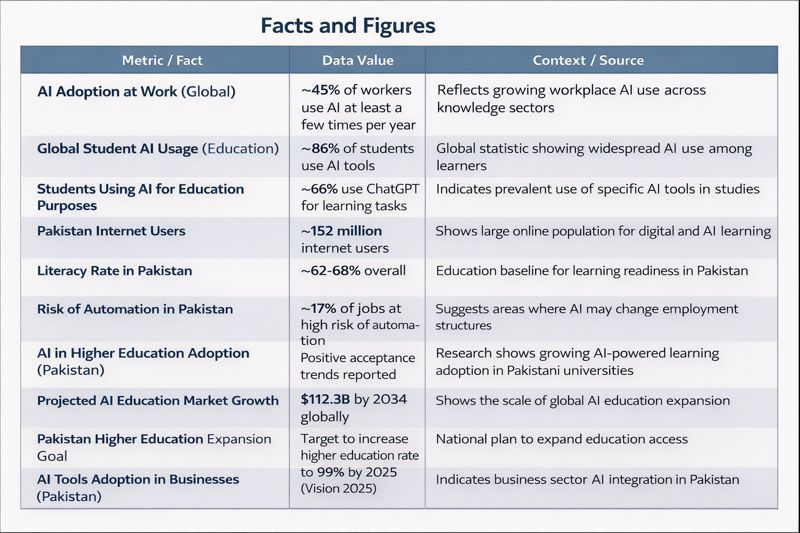
In Pakistan, the impact of artificial intelligence on the value of university degrees is becoming increasingly visible. Each year, thousands of graduates enter the job market with traditional degrees in business, IT, and social sciences, yet many struggle to find roles aligned with their education. At the same time, AI-powered tools are enabling students and professionals to acquire practical, job-ready skills outside formal degree programs. Freelancers, software developers, digital marketers, and data analysts in Pakistan are using AI to learn faster, work more efficiently, and compete globally through platforms like Upwork and Fiverr. This shift highlights a growing gap between conventional academic curricula and the skills demanded by both local employers and international clients.
However, this transformation also presents an opportunity for Pakistan rather than a setback. Universities that integrate AI literacy, hands-on projects, and industry collaboration into their programs can significantly improve graduate employability. For a country with a young population and rising internet access, AI-enabled learning can help bridge skill gaps, reduce unemployment, and support participation in the global digital economy. Degrees in Pakistan are still valuable, but their relevance increasingly depends on how well they are combined with practical experience, continuous learning, and the effective use of artificial intelligence.
Conclusion
Artificial intelligence is influencing the perceived value of some traditional university degrees, particularly those that rely heavily on static knowledge. At the same time, it is creating new opportunities for institutions and learners willing to adapt.
Degrees remain important, but they are no longer the sole indicator of readiness or capability. In an AI-enabled world, education works best when combined with practical experience, adaptability, and lifelong learning.
Rather than signaling the end of higher education, AI represents a transition toward a more flexible and skills-focused learning ecosystem.
Leave a Reply