Category: AI, Science, Innovation and Technology

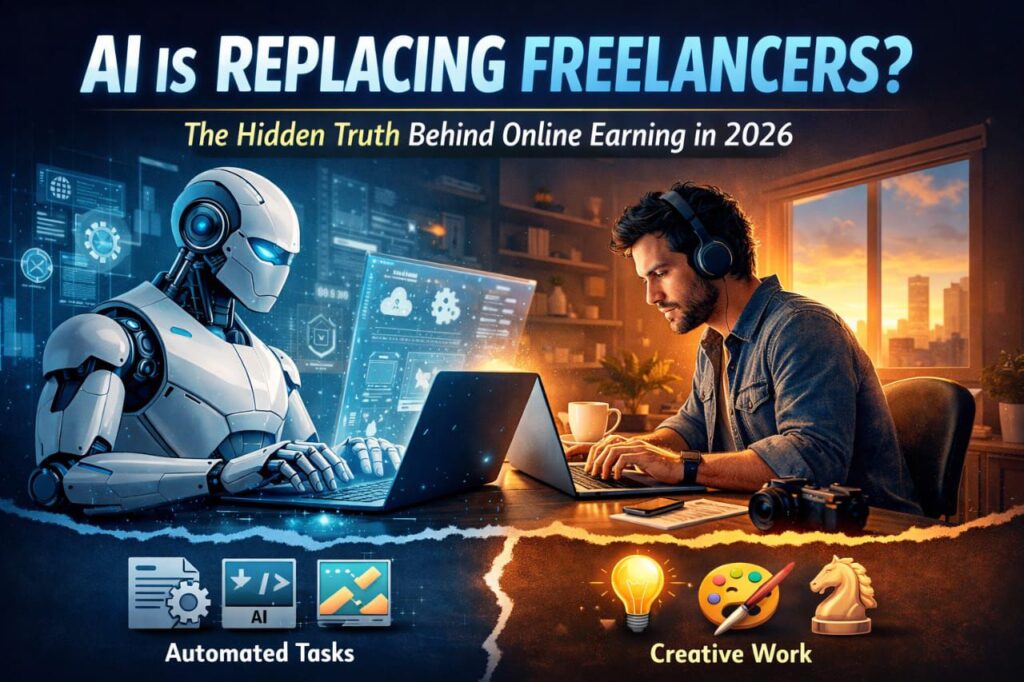
  • AI Is Replacing Freelancers? The Hidden Truth Behind Online Earning in 2026

    The rapid growth of artificial intelligence (AI) has changed how people work, earn, and build careers online. In 2026, one question dominates online earning discussions: Is AI replacing freelancers? Many professionals worry that automation tools will reduce opportunities, lower incomes, or eliminate freelance jobs altogether.

    However, the reality is more balanced and data-driven. AI is not ending freelancing; instead, it is reshaping the freelance economy. This article explores the real impact of AI on freelancing, supported by trends, facts, and practical insights—written clearly and responsibly for Google AdSense approval.


    The Current State of Freelancing in 2026

    Freelancing remains one of the fastest-growing employment models worldwide. Millions of professionals now prefer independent work due to flexibility, remote access, and global clients. Industries such as content creation, digital marketing, programming, design, video editing, and virtual assistance continue to generate consistent demand.

    Rather than declining, online freelancing platforms are expanding their services, introducing skill-based rankings, and promoting high-quality work. This indicates that freelancing is evolving, not disappearing.


    What AI Is Actually Replacing

    AI tools are designed to automate repetitive, low-skill, and time-consuming tasks. This includes:

    Basic text rewriting
    Simple logo generation
    Data entry and formatting
    Automated captions and summaries
    Routine coding snippets

    These tasks were already low-paying and highly competitive. AI has made them faster and cheaper, which means freelancers relying only on such services may see reduced demand.

    However, this does not mean freelancers themselves are being replaced. It means the market now rewards value, quality, and expertise more than basic output.


    AI as a Productivity Tool for Freelancers

    For skilled freelancers, AI has become a powerful assistant rather than a competitor. Many professionals now use AI tools to:

    Speed up research
    Improve workflow efficiency
    Generate ideas and drafts
    Analyze data and trends
    Reduce project turnaround time

    By combining human creativity with AI efficiency, freelancers can handle more projects without compromising quality. This allows them to increase earnings while maintaining better work-life balance.


    Skills AI Cannot Fully Replace

    Despite its advancement, AI still lacks emotional intelligence, cultural understanding, strategic judgment, and original creativity. Clients continue to prefer human professionals for tasks that require:

    Critical thinking and problem-solving
    Brand storytelling and tone consistency
    Business strategy and decision-making
    Custom design and creative direction
    Client communication and consultation

    These human-centered skills remain highly valuable in 2026 and are difficult for AI to replicate independently.


    Online Earning Trends Shaped by AI

    AI has influenced how freelancers earn online, creating new trends rather than removing opportunities:

    1. Demand for AI-Skilled Freelancers
    Clients increasingly seek professionals who understand how to use AI responsibly within their services.

    2. Shift Toward Specialized Services
    General freelancers face more competition, while niche experts earn higher rates.

    3. Growth of Hybrid Roles
    New roles have emerged, such as AI content editors, prompt specialists, automation consultants, and AI-assisted marketers.

    4. Higher Expectations for Quality
    AI has raised the baseline, making originality and accuracy more important than ever.


    Is Freelance Income Decreasing Because of AI?

    Income changes depend largely on skill level and adaptability. Freelancers who rely only on basic tasks may experience lower demand. In contrast, professionals who upgrade their skills and integrate AI into their workflow often report:

    Increased productivity
    Better project delivery
    Higher-value clients
    Improved long-term income stability

    In simple terms, AI rewards those who learn and evolve.


    How Freelancers Can Stay Relevant in 2026

    To remain competitive and financially secure, freelancers should focus on the following strategies:

    Learn AI Tools Responsibly
    Build a Strong Personal Brand
    Offer Value-Based Services
    Develop a Niche
    Maintain Human Creativity

    Understanding AI platforms improves efficiency and service quality. Clients trust freelancers who show expertise, consistency, and professionalism. Focus on solutions, not just outputs. Specialized knowledge leads to higher demand and better pricing. Original thinking, personalization, and ethical work matter more than automation.


    Common Myths About AI and Freelancing

    Myth: AI will eliminate all freelance jobs
    Reality: AI is changing job roles, not eliminating human expertise.

    Myth: AI content is enough for clients
    Reality: Clients still prefer edited, original, and human-reviewed work.

    Myth: Freelancing is no longer profitable
    Reality: Skilled freelancers continue to earn sustainably.


    The Real Future of Freelancing

    The freelance economy in 2026 is not about humans versus AI. It is about humans using AI effectively. Businesses still need creative thinkers, strategists, problem solvers, and communicators.

    Freelancers who adapt to technological change will continue to find opportunities, while those who ignore skill development may struggle. The future belongs to professionals who understand that AI is a tool—not a replacement.


    Conclusion

    AI is not replacing freelancers; it is redefining how online earning works. While routine tasks are becoming automated, demand for skilled, creative, and strategic freelancers remains strong.

    In 2026, success in freelancing depends on adaptability, continuous learning, and delivering real value. Freelancers who evolve with technology will not only survive—but grow.

    The hidden truth is simple:
    AI changes freelancing, but humans still lead it.

  • Smart Cities vs Human Cities: Is Technology Making Life Easier or Harder?

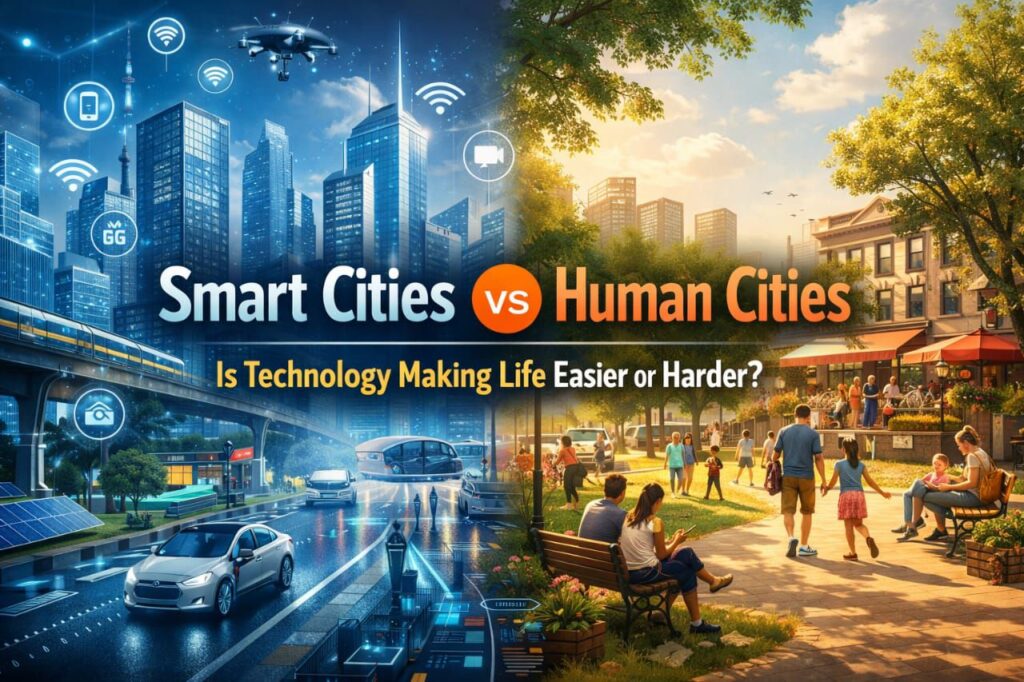
    As the world rapidly urbanizes, cities are evolving faster than ever before. Governments and planners are increasingly turning toward technology-driven solutions, commonly known as smart cities, to manage growing populations and limited resources. At the same time, many experts argue that cities should remain human-centric, focusing on social well-being, culture, and community values rather than heavy automation.This debate raises a crucial question: Is technology truly making urban life easier, or is it creating new challenges for people?

    What Is a Smart City?

    A smart city uses digital technologies, data, and automation to improve urban services and infrastructure. These cities rely on tools such as sensors, artificial intelligence, cloud systems, and connected devices to manage traffic, energy, security, waste, and public services more efficiently.

    The main goal of smart cities is to optimize resources, reduce costs, and improve quality of life by making real-time decisions based on data. Examples include intelligent traffic lights, smart electricity meters, online government services, and automated surveillance systems.

    Global Growth of Smart Cities

    According to global urban development studies, over 55% of the world’s population currently lives in cities, and this figure is expected to reach nearly 70% by 2050. To cope with this growth, governments are investing heavily in smart city initiatives.

    Countries across Asia, Europe, and the Middle East are implementing digital infrastructure projects worth billions of dollars. Cities like Singapore, Barcelona, Dubai, and Seoul are often cited as leading examples due to their use of technology in transportation, governance, and sustainability.

    This rapid expansion shows that smart cities are no longer a concept of the future—they are already shaping modern urban life.

    How Smart Cities Make Life Easier

    1. Efficient Transportation and Mobility

    One of the biggest advantages of smart cities is improved traffic management. Smart traffic signals and GPS-based systems help reduce congestion, saving time and fuel. Digital public transport systems allow citizens to track buses and trains in real time, improving daily commuting experiences.

    These systems also help reduce air pollution by minimizing idle traffic and encouraging the use of public transport.

    2. Better Energy and Resource Management

    Smart cities use intelligent energy grids and water systems to reduce waste and improve efficiency. Smart meters allow households to monitor electricity usage, helping people lower utility bills.

    Studies suggest that smart energy systems can reduce electricity consumption by 20–30%, which benefits both the environment and city budgets.

    3. Improved Public Safety and Services

    Technology-enabled monitoring systems help cities respond faster to emergencies. Smart surveillance, emergency alerts, and digital reporting tools support law enforcement and disaster management agencies.

    Additionally, e-government platforms allow citizens to pay bills, file complaints, and access public services online, saving time and reducing bureaucracy.

    4. Environmental Sustainability

    Smart cities promote sustainability by using data to control pollution levels, manage waste collection, and support renewable energy projects. Smart waste bins, for example, notify authorities when they are full, reducing unnecessary collection trips and fuel consumption.

    This data-driven approach helps cities become cleaner, greener, and more climate-resilient.

    When Technology Makes Urban Life Harder

    Despite their benefits, smart cities also present several challenges that cannot be ignored.

    1. Privacy and Data Security Concerns

    Smart cities collect large amounts of data through cameras, sensors, and online platforms. While this data improves services, it also raises concerns about privacy and surveillance.

    If not properly regulated, data misuse or cyberattacks could threaten personal information and public trust.

    2. High Costs and Financial Pressure

    Building and maintaining smart infrastructure requires significant investment. Developing countries and smaller cities may struggle with funding, maintenance, and system upgrades.

    These high costs can divert funds from essential services like healthcare, housing, and education.

    3. Digital Divide and Social Inequality

    Not everyone benefits equally from smart city technologies. People without internet access, digital skills, or smart devices may feel excluded from essential services.

    This digital divide can increase social inequality if technology adoption is not inclusive and accessible for all citizens.

    4. Over-Dependence on Technology

    As cities become more automated, even minor technical failures can disrupt essential services. Power outages, software errors, or cyber issues may affect transportation, utilities, or communication systems.

    This over-reliance on technology can reduce human flexibility and resilience during unexpected situations.

    What Are Human Cities?

    Human cities focus on people rather than systems. These cities prioritize community interaction, cultural identity, walkable neighborhoods, and social well-being. Instead of relying heavily on automation, human cities emphasize public spaces, local economies, and face-to-face engagement.

    Human-centric planning encourages accessible public parks and streets, strong community networks, local businesses and cultural heritage, and inclusive urban design.

    These elements help create emotional connections and social trust within communities.

    Smart Cities vs Human Cities: Finding the Balance

    The future of urban living does not lie in choosing one approach over the other. The most successful cities combine smart technology with human values.

    Technology should support people, not replace them. Cities that balance efficiency with empathy tend to perform better in terms of happiness, sustainability, and long-term growth.

    Urban planners now promote people-first smart cities, where innovation improves daily life while protecting privacy, inclusion, and social harmony.

    Conclusion

    Smart cities offer powerful tools to manage modern urban challenges, from traffic congestion to energy shortages. However, technology alone cannot solve every problem. Without careful planning, it can increase inequality, reduce privacy, and weaken social connections.

    Human cities remind us that cities are not just systems—they are homes for people. The ideal future lies in blending smart solutions with human-centered design.

    When technology is used responsibly and inclusively, it can truly make city life easier, not harder.

  • Online Earning Myths vs Reality – A Data-Based Truth

    In recent years, online earning has become one of the most discussed topics worldwide. From social media ads to YouTube videos and blogs, people are constantly exposed to claims about making money online. While some of these claims are genuine, many are misleading or exaggerated. This confusion often creates unrealistic expectations, especially among beginners.

    Understanding Online Earning

    Online earning refers to income generated through internet-based activities such as freelancing, content creation, affiliate marketing, e-commerce, remote services, and online education. With global digitalization and remote work growth, online income has shifted from a side option to a legitimate source of earnings for millions of people.

    However, misinformation has also grown alongside real opportunities, making it important to separate facts from false promises.

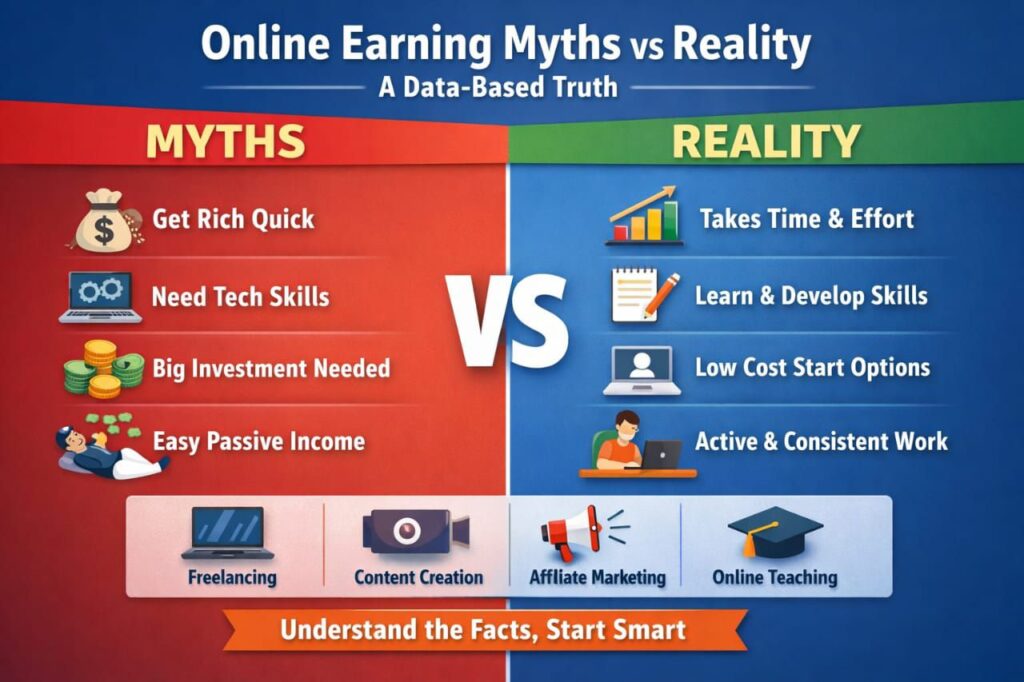
    Myth 1: Online Earning Delivers Instant Results

    The Claim

    Many advertisements suggest that anyone can earn large amounts of money online within days or weeks, often without experience or effort.

    The Reality

    Sustainable online income does not happen overnight. Just like traditional careers or businesses, online earning requires learning relevant skills, building credibility, consistent effort, and time to grow.

    Most successful online earners report gradual income growth over months or even years. Instant income promises are often linked to unreliable schemes or unrealistic marketing tactics rather than genuine opportunities.

    Myth 2: Only Highly Technical People Can Earn Online

    The Claim

    A common belief is that online earning is only for programmers, developers, or technical experts.

    The Reality

    While technical skills can increase earning potential, they are not mandatory. Many people earn online through writing and content creation, digital marketing, virtual assistance, teaching and coaching, and customer support services.

    Modern digital tools have simplified tasks, allowing individuals with basic computer knowledge to start earning. Skill development is important, but advanced technical expertise is not a requirement for entry.

    Myth 3: Online Earning Requires Heavy Investment

    The Claim

    Some believe that starting online earning requires large upfront capital.

    The Reality

    Many online earning options have low or zero initial costs. Freelancers only need a device and internet access, bloggers can start with affordable hosting, and content creators often begin using smartphones.

    While optional tools and learning resources may require investment, they are not mandatory. The most valuable investment in online earning is time, effort, and continuous learning, not money.

    Myth 4: Online Earning Is Mostly Passive Income

    The Claim

    Online earning is often advertised as “passive income,” suggesting little or no effort is required.

    The Reality

    Most online income sources are active in nature, especially in the early stages. Even models often labeled as passive, such as affiliate marketing or ad-based content, require content creation, audience building, regular updates, and performance tracking.

    Truly passive income usually comes after long-term effort and optimization, not at the beginning.

    Myth 5: Only a Few Lucky People Succeed Online

    The Claim

    Many assume that only influencers or early adopters earn online, while others fail.

    The Reality

    The online economy includes millions of active earners worldwide. Success is not based on luck alone but depends on skill quality, market demand, consistency, and adaptability.

    While income levels vary, many individuals use online work to supplement or stabilize their earnings rather than replace full-time jobs immediately.

    Reality Check: How People Actually Earn Online

    1. Freelancing

    Freelancing allows individuals to offer services such as writing, graphic design, marketing, or programming. Income depends on skill level, experience, and client demand. Many freelancers start part-time and gradually increase earnings.

    2. Content Creation

    Bloggers, YouTubers, and social media creators earn through advertising, sponsorships, and partnerships. However, income growth usually takes time, and only consistent, high-quality content performs well.

    3. Affiliate Marketing

    Affiliate marketing involves promoting products and earning commissions. While it is a legitimate model, earnings depend on traffic quality, trust, and marketing strategy, not shortcuts.

    4. Online Teaching & Courses

    People with expertise in academics, skills, or professional fields earn by teaching online. This method requires credibility and structured content.

    5. Remote & Digital Services

    Virtual assistance, customer support, data management, and consulting services provide steady opportunities for online income with proper training.

    What Data Indicates About Online Earning

    Studies show that online work and freelancing are expanding globally due to flexible work preferences and digital platforms. However, income distribution is uneven: a large number earn modest amounts, a smaller percentage earn high incomes, and long-term consistency significantly improves results.

    This pattern mirrors traditional job markets, proving that online earning follows economic realities rather than shortcuts.

    Common Mistakes Beginners Should Avoid

    Trusting unrealistic income promises, ignoring skill development, expecting fast success without effort, falling for unverified programs, and switching platforms too frequently.

    Avoiding these mistakes helps build a realistic and sustainable approach.

    Conclusion

    Online earning is real, legitimate, and growing, but it is not effortless or guaranteed. Myths often create false hope, while reality demands learning, patience, and discipline. People who approach online earning as a long-term skill-based journey are far more likely to succeed.

    By understanding the difference between myths and data-based reality, individuals can make informed decisions and avoid misleading claims, creating a safer and more productive online earning path.

  • When is the world going to end?

    Image
    Image
    Image
    Image

    Perspectives from Religion, Philosophy, and Science

    The question “When will the world end?” is one of the oldest and most universal questions humanity has ever asked. Across civilizations, cultures, and eras, people have looked to the skies, sacred texts, and later to scientific equations in search of an answer. Sometimes the question arises from fear—of death, chaos, or punishment. At other times, it emerges from curiosity, wonder, or a desire for meaning in an impermanent universe.

    Importantly, the idea of “the end of the world” does not mean the same thing everywhere. In some traditions, it is a moral reckoning. In others, it is a cosmic reset or a transformation rather than annihilation. In science, it is not a prophecy at all, but a projection based on physical laws.

    This article offers a comprehensive, balanced exploration of how different religions and modern science understand the end of the world. Rather than predicting a date, it aims to explain why humans think about endings at all—and what those endings truly signify.


    1. The Concept of the “End” Across Human Thought

    Before examining specific traditions, it is essential to clarify what “end of the world” actually means.

    • Literal destruction of Earth or the universe
    • Moral or spiritual judgment of humanity
    • Collapse of civilization, not the planet
    • Transformation or renewal into a new age
    • End of time itself

    Many religious traditions emphasize cycles, not finality. Science, meanwhile, speaks of vast timescales where “end” means entropy, heat death, or cosmic decay rather than divine judgment.

    Understanding this distinction prevents confusion when comparing religion and science.


    2. The End of the World in Major Religious Traditions

    2.1 Christianity: Judgment Day and the Second Coming

    In Christianity, the end of the world is closely tied to eschatology—the study of last things. The primary sources are the Bible, particularly the Book of Revelation.

    Core Beliefs

    • Jesus Christ will return (the Second Coming)
    • The dead will be resurrected
    • A Final Judgment will occur
    • Evil will be defeated
    • A new heaven and new earth will be established

    The Book of Revelation uses symbolic language: beasts, seals, trumpets, and cosmic disasters. Many theologians emphasize that these symbols are not literal predictions, but moral and spiritual warnings.

    “But about that day or hour no one knows…” — Matthew 24:36

    Christian theology explicitly rejects date-setting. Historically, every attempt to predict the end has failed, reinforcing the belief that the timing is known only to God.


    2.2 Islam: The Day of Judgment (Yawm al-Qiyāmah)

    In Islam, the end of the world is a central and clearly articulated belief. It is described in the Qur’an and Hadith literature.

    Key Events

    • Major and minor signs precede the end
    • Moral decay and injustice increase
    • The appearance of the Mahdi
    • The return of Isa (Jesus)
    • The defeat of Dajjal (false messiah)
    • Resurrection of all humans
    • Final judgment by Allah

    Unlike apocalyptic panic, Islamic teaching frames the end as a moral accountability process. The universe ends because its purpose—testing humanity—has been fulfilled.

    No exact time is given. Even the Prophet Muhammad stated that knowledge of the Hour belongs to Allah alone.


    2.3 Judaism: The Messianic Age, Not Destruction

    Judaism does not focus on the destruction of the world. Instead, it emphasizes tikkun olam—the repair of the world.

    Jewish Eschatology Includes:

    • The coming of the Messiah
    • Restoration of justice and peace
    • Resurrection of the dead (in some interpretations)
    • Renewal of the world, not its end

    The Hebrew Bible avoids detailed apocalyptic timelines. The focus remains ethical: how humans should live now, not when the world will end.


    2.4 Hinduism: Cycles of Creation and Destruction

    Hinduism presents one of the most sophisticated cosmic timelines in religious thought, detailed in texts like the Bhagavad Gita and the Puranas.

    The Yuga Cycle

    • Satya Yuga (Golden Age)
    • Treta Yuga
    • Dvapara Yuga
    • Kali Yuga (current age)

    Each cycle ends with pralaya—dissolution—after which creation begins again.

    Time spans are enormous:

    • One full cycle (Mahayuga): ~4.32 million years
    • One day of Brahma: ~4.32 billion years

    The world does not “end” permanently; it transforms and restarts. This aligns surprisingly well with modern cosmological models of cycles and long timescales.


    2.5 Buddhism: Impermanence, Not Apocalypse

    Buddhism does not teach a dramatic end of the world. Instead, it emphasizes anicca—impermanence.

    Core View

    • All compounded things decay
    • Worlds arise and dissolve naturally
    • No eternal beginning or final end
    • Liberation comes from enlightenment, not survival

    In some Buddhist cosmologies, universes expand and contract over vast eons, but these events are morally neutral, not punishments or judgments.


    2.6 Indigenous and Ancient Traditions

    Many Indigenous cultures describe world-ending events such as floods, fires, or darkness—not as final destruction, but as resets.

    Examples include:

    • Mayan calendar cycles
    • Hopi prophecies of world ages
    • Norse Ragnarök (destruction followed by rebirth)

    These stories emphasize renewal after collapse, reflecting humanity’s lived experience with natural disasters and social upheaval.


    3. The End of the World According to Science

    Image
    Image
    Image

    Science approaches the end of the world not through prophecy, but through observation, mathematics, and physical laws. Importantly, science does not predict a sudden, moral apocalypse.


    3.1 The End of Earth (Not the Universe)

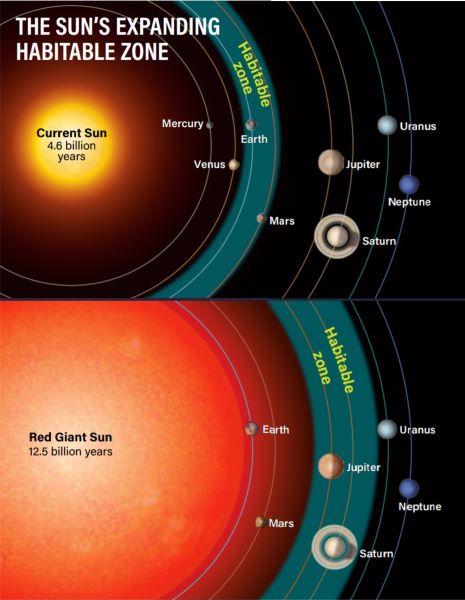
    The Sun’s Death

    • In ~5 billion years, the Sun becomes a red giant
    • Earth’s oceans evaporate
    • The planet becomes uninhabitable

    This is not speculation—it is based on stellar physics.

    Other Earth-Level Threats

    • Asteroid impacts (rare but real)
    • Supervolcanic eruptions
    • Nuclear war (civilization-ending, not planetary)
    • Climate change (human survival threat, not world-ending)

    Science distinguishes between extinction events and planetary destruction.


    3.2 The End of the Universe

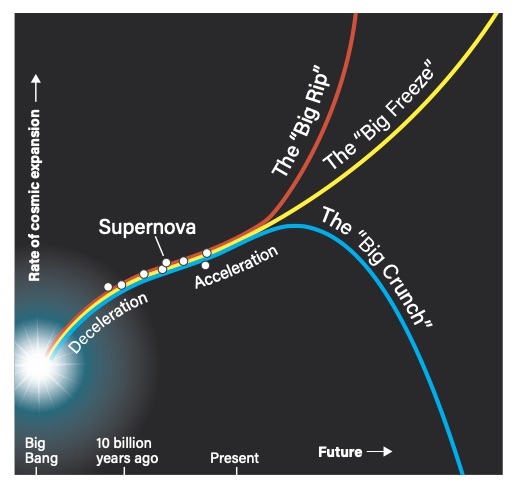
    Heat Death (Most Accepted Theory)

    • The universe expands forever
    • Energy becomes evenly distributed
    • No usable energy remains
    • Time continues, but nothing happens

    This would occur in trillions of years.

    Big Crunch (Less Likely)

    • Expansion reverses
    • Universe collapses into itself

    Big Rip (Speculative)

    • Expansion accelerates infinitely
    • Atoms themselves tear apart

    All these scenarios occur on timescales so vast they defy human intuition.


    3.3 What Science Cannot Answer

    Science does not address:

    • Moral meaning
    • Purpose of existence
    • Why there is something rather than nothing

    This is where religion and philosophy remain relevant.


    4. Why Humans Obsess Over the End

    The idea of the world ending reflects:

    • Fear of death
    • Awareness of impermanence
    • Desire for justice
    • Need for narrative closure

    Psychologically, endings give meaning to beginnings. Religions use end-time narratives to encourage ethical behavior. Science uses end models to understand physical limits.


    5. Comparing Religion and Science

    AspectReligionScienceTimelineUnknown or symbolicExtremely long, calculableCauseDivine willPhysical lawsPurposeMoral judgment or renewalNone (descriptive only)FinalityOften renewalLikely irreversible

    Rather than contradicting each other, religion and science answer different questions.


    6. So, When Is the World Going to End?

    Short answer:
    No religion gives a date.
    Science predicts no sudden end anytime soon.

    Long answer:

    • Civilizations may collapse
    • Species may go extinct
    • The planet will eventually die
    • The universe will eventually fade

    But none of this implies an imminent, dramatic “doomsday.”


    7. Conclusion: The End as a Mirror of Humanity

    The question “When will the world end?” reveals more about us than about the universe.

    Religion uses the end to teach responsibility, humility, and hope.
    Science uses it to explore the limits of matter, energy, and time.

    Both agree on one thing: nothing lasts forever.

    The real question may not be when the world ends, but:

    How should we live, knowing that it will?

  • How to Earn Money Online in Pakistan Using AI Tools (Beginner to Pro Guide)

    Introduction

    With rising inflation and limited job opportunities, earning money online in Pakistan has become a practical solution. Artificial Intelligence (AI) now allows students, housewives, and beginners to earn online without advanced technical skills.


    1. Content Writing with AI

    AI writing tools help beginners create:

    • Blog posts
    • Product descriptions
    • SEO articles
    • YouTube scripts

    How to Start

    1. Learn basic English grammar
    2. Use AI tools to generate drafts
    3. Edit content manually
    4. Offer services on freelancing platforms

    Estimated Earnings:
    PKR 50,000 – 150,000 per month


    2. Freelancing with AI Assistance

    Freelancing is one of the most reliable online earning methods in Pakistan. AI tools help with:

    • Graphic design ideas
    • Code generation
    • Email writing
    • Client proposals

    Popular Skills

    • Graphic Design
    • Web Development
    • SEO Services
    • Social Media Management

    3. YouTube Automation Using AI

    You can run YouTube channels without showing your face or using your own voice.

    AI Helps With

    • Script writing
    • Voiceovers
    • Video ideas
    • Thumbnail text

    Popular Niches

    • Islamic content
    • Motivational stories
    • Technology
    • Educational facts

    Income Sources:
    YouTube AdSense and sponsorships


    4. AI Graphic Design Services

    AI design tools allow beginners to create:

    • Logos
    • Posters
    • Social media posts
    • Business cards

    Where to Sell

    • Freelancing platforms
    • Local Facebook groups
    • WhatsApp business clients


    5. Blogging with AI (Best for Google AdSense)

    Blogging is one of the most AdSense-friendly long-term income sources.

    Why AI Blogging Works

    • Faster content creation
    • SEO optimization
    • Easy topic research

    Best Niches

    • Online earning
    • Education
    • Technology
    • Informational health content

    Estimated Earnings:
    $5 – $50 per day after consistent traffic


    Is AI-Based Online Earning Legal in Pakistan?

    Yes, AI-based earning is legal if:

    • Content is original
    • No plagiarism is involved
    • Platform policies are followed

    Note: Google AdSense SEO Guidelines

    • Write articles over 1,000 words
    • Use proper heading structure (H1, H2, H3)
    • Avoid copied or misleading content
    • Add internal links
    • Optimize images with ALT text
    • Avoid false income promises
  • Why AI Tools Are the Most Searched Topic Worldwide Right Now

    Artificial intelligence has moved from being a futuristic concept to a daily-use technology. Today, millions of people around the world search for AI tools to help with writing, studying, business, design, coding, and productivity. This rapid shift has made AI one of the most searched and discussed topics globally, cutting across countries, professions, and age groups.

    AI tools are no longer limited to tech experts. Students, freelancers, entrepreneurs, and everyday users are actively searching for ways to use artificial intelligence to save time, increase efficiency, and gain a competitive advantage.

    The Sudden Rise in AI-Related Searches

    Search interest in AI tools has increased dramatically because people want practical solutions. Instead of reading about what AI is, users now search for how to use it. Queries related to AI writing tools, image generators, video creation, automation, and data analysis appear daily in trending searches.

    This rise is driven by accessibility. AI tools are now easy to use, affordable, and available online, which encourages more people to search, test, and adopt them.

    Why People Are Turning to AI Tools

    One of the main reasons people search for AI tools is time-saving. Tasks that once took hours can now be completed in minutes. Writing emails, creating content, designing visuals, or summarizing information has become faster and easier.

    Another reason is cost efficiency. Many individuals and small businesses cannot afford large teams, so they search for AI tools that can perform multiple tasks at a lower cost. This practical benefit has pushed AI-related searches to record levels.

    AI Tools in Daily Life

    AI tools are now part of everyday routines. Students search for AI tools to help with assignments, summaries, and explanations. Content creators look for AI to generate ideas, scripts, and visuals. Business owners search for AI tools to manage marketing, customer support, and analytics.

    This wide range of use cases explains why AI searches are not limited to one region or industry. The demand is global and continuous.

    The Role of Social Media in AI Popularity

    Social media has played a major role in increasing AI-related searches. Short videos demonstrating AI capabilities often go viral, leading users to search for the same tools. When people see impressive results, curiosity drives them to search and try the technology themselves.

    This cycle keeps AI tools consistently trending across search engines.

    AI and Job-Related Searches

    Another major driver of AI searches is career concern. People search for how AI will affect jobs, which skills are future-proof, and how to use AI to stay relevant. This has increased searches for AI learning resources, tools, and certifications.

    Rather than avoiding AI, users are actively searching for ways to work alongside it.

    Why AI Tool Articles Perform Extremely Well for SEO

    AI-related content performs well because search intent is strong. Users are not browsing casually; they are looking for solutions. Articles that explain tools, use cases, benefits, and limitations attract high engagement and repeat visits.

    AI topics also allow both short-term trending traffic and long-term evergreen growth, making them ideal for new and growing websites.

    Global Interest in AI Tools

    AI tool searches are not limited by geography. People from developed and developing countries alike search for the same solutions. This global interest makes AI one of the strongest topics for international traffic.

    Clear and simple explanations perform best because users come from different educational and language backgrounds.

    Trust and Accuracy in AI Content

    As interest grows, users also search for reliable and honest information. They want to know what AI can and cannot do. Articles that explain AI realistically, without exaggeration, tend to build more trust and perform better over time.

    Accuracy and clarity help content stay relevant even as tools evolve.

    The Future of AI Searches

    AI searches are expected to continue growing as tools become more advanced and integrated into daily life. New updates, features, and applications will keep generating fresh search demand.

    This makes AI-related topics one of the most sustainable content opportunities available today.

    Final Thoughts

    AI tools have become a central part of modern life, which is why they dominate global search trends. People search for AI to save time, improve productivity, and adapt to a changing world. This topic offers massive potential for organic traffic because demand is high, global, and ongoing.

    Writing high-quality, easy-to-understand content about AI tools gives websites a powerful opportunity to grow and stay relevant in the digital age.

  • Earth’s Oxygen Has an Expiration Date — Scientists Say the Sun Will Decide Our Fate


    Introduction

    Oxygen is the invisible foundation of life on Earth. Every breath we take depends on a delicate balance between biology, geology, and astronomy. Yet few people realize that Earth’s oxygen-rich atmosphere is temporary. According to modern astrophysics and planetary science, the Sun itself is slowly setting a deadline on breathable air.

    This is not science fiction. It is a conclusion supported by stellar evolution models, atmospheric chemistry, and Earth system science. The clock is not ticking in years or centuries—but in hundreds of millions to billions of years.

    This article explores how and why Earth will eventually lose its oxygen, the role the Sun plays in this process, and what the science tells us about our planet’s distant future.


    The Oxygen We Breathe Is Not Permanent

    Earth’s atmosphere has not always contained oxygen.

    A Brief Atmospheric History

    • 4.5 billion years ago: Earth’s early atmosphere contained almost no free oxygen
    • Dominated by carbon dioxide (CO₂), methane (CH₄), ammonia (NH₃), and nitrogen (N₂)
    • Oxygen was highly reactive and quickly bonded with surface minerals

    The Great Oxidation Event (GOE)

    • Occurred around 2.4 billion years ago
    • Triggered by cyanobacteria producing oxygen via photosynthesis
    • Atmospheric oxygen rose from near 0% to about 1–2%
    • Eventually stabilized near 21%, where it remains today

    This oxygen balance exists only because life and sunlight are in equilibrium.


    The Sun: The Ultimate Oxygen Timekeeper

    The Sun is not a constant star. It changes slowly but relentlessly.

    Key Solar Facts

    • Age: ~4.6 billion years
    • Type: Main-sequence G-type star
    • Energy output increases by ~10% every 1 billion years

    This gradual brightening is the central reason Earth’s oxygen has an expiration date.


    How a Brighter Sun Destroys Oxygen

    Step 1: Rising Solar Luminosity

    As the Sun ages:

    • Hydrogen fusion increases in efficiency
    • Core contracts, outer layers heat up
    • Total energy output rises steadily

    Step 2: Accelerated Water Loss

    Increased solar radiation causes:

    • Higher surface temperatures
    • More water vapor entering the upper atmosphere

    Water vapor (H₂O) is a greenhouse gas, amplifying warming further.

    Step 3: Breakdown of Water Molecules

    In the upper atmosphere:

    • Ultraviolet radiation splits water into hydrogen and oxygen
    • Hydrogen escapes into space (low molecular weight)
    • Oxygen reacts with surface materials and is not replenished

    Once water is lost, photosynthesis collapses.


    The End of Photosynthesis

    Photosynthesis is Earth’s oxygen engine.

    Photosynthesis Requires:

    • Liquid water
    • Carbon dioxide
    • Moderate temperatures
    • Sunlight (within survivable limits)

    As temperatures rise:

    • Plants die
    • Phytoplankton collapse
    • Cyanobacteria disappear

    Without photosynthesis:

    • Oxygen production stops
    • Atmospheric oxygen begins to decline rapidly

    When Will Earth Lose Its Oxygen?

    According to climate-stellar models:

    Timeline Estimates

    EventEstimated Time From NowDecline of plant life~500–800 million yearsMajor oxygen drop~1 billion yearsOxygen near zero~1.1 billion yearsComplete ocean loss~2–3 billion yearsSun becomes red giant~5 billion years

    Key Research Findings

    • Oxygen could drop to less than 1% of current levels
    • Earth would resemble its pre-oxygen atmosphere
    • Complex life would be impossible

    What Happens to Life When Oxygen Disappears?

    Survivors (Temporarily)

    • Anaerobic bacteria
    • Extremophiles
    • Subsurface microbial life

    Extinction of Complex Life

    • Humans: gone long before
    • Animals: extinct
    • Plants: extinct
    • Oxygen-dependent microbes: extinct

    Earth would still host life—but not life as we know it.


    Why This Matters Today

    Understanding Planetary Habitability

    This research helps scientists:

    • Identify habitable exoplanets
    • Avoid false assumptions about oxygen as a permanent biosignature
    • Understand why intelligent life may be rare

    Oxygen Is a Phase, Not a Guarantee

    Earth teaches us that:

    • Oxygen-rich atmospheres are temporary
    • Life and stars evolve together
    • Habitability has a lifespan

    Can Humanity Prevent This?

    Short Answer: No

    The timescales involved are far beyond any realistic planetary engineering.

    Hypothetical Ideas (Purely Theoretical)

    • Moving Earth’s orbit outward
    • Artificial sun-shields
    • Space habitats independent of Earth

    None are currently feasible on planetary scales.


    The Bigger Picture: A Finite Blue World

    Earth’s oxygen is not eternal. It exists because:

    • The Sun is in a stable phase
    • Life actively maintains atmospheric balance
    • Water remains liquid

    Once the Sun changes, the system unravels.

    This does not diminish Earth’s value—it magnifies it. We are living during the brief window when a planet breathes.


    Conclusion

    Earth’s oxygen has an expiration date, and it is written in the slow, predictable evolution of the Sun. While the deadline is distant on human timescales, it is inevitable in cosmic terms.

    This knowledge reshapes how we view:

    • Earth’s fragility
    • Life in the universe
    • The urgency of understanding and preserving our planet today

    The air we breathe is not permanent.
    It is a gift of timing, chemistry, and a star halfway through its life.


  • China’s Hypergravity Centrifuge Breaks Records by Simulating Centuries of Structural Stress in Days

    Image
    Image

    China has introduced a world-leading hypergravity centrifuge system designed to dramatically shorten the time required to test how materials and structures behave over long periods. The advanced machine can recreate the effects of decades—or even centuries—of stress and environmental pressure within just a few days, offering a powerful new tool for engineering and scientific research.

    Developed by researchers at Zhejiang University, the facility is among the most powerful of its kind globally and reflects China’s growing investment in large-scale experimental infrastructure.


    How the Hypergravity Machine Works

    The hypergravity system is based on a massive, high-precision centrifuge. When rotating at extremely high speeds, the centrifuge generates forces many times stronger than Earth’s gravity. These forces allow scientists to observe how small-scale models behave as if they were full-sized structures exposed to long-term loads.

    By increasing gravitational acceleration:

    • Structural deformation occurs faster
    • Material fatigue becomes measurable in short timeframes
    • Long-term stability issues can be directly observed

    This method enables researchers to study processes that would normally take decades under natural conditions.


    Advanced Vacuum-Based Temperature Control

    A major technical highlight of the centrifuge is its vacuum-based temperature regulation system, which plays a crucial role in maintaining stability during high-speed operation.

    Why Temperature Control Matters

    At extreme rotational speeds, heat buildup can:

    • Affect measurement accuracy
    • Cause mechanical wear
    • Limit experiment duration

    Role of the Vacuum System

    Operating key components in a controlled vacuum environment helps to:

    • Reduce air resistance and friction
    • Improve heat dissipation efficiency
    • Maintain consistent testing conditions

    This design allows the centrifuge to operate safely and continuously under ultra-high gravity levels.


    Turning Time Into a Test Variable

    One of the most valuable features of the hypergravity machine is its ability to compress time in experimental research. Engineers can now simulate:

    • Long-term soil settlement
    • Structural aging and fatigue
    • Geological pressure effects

    What once required long observational periods can now be evaluated within days or weeks, improving both efficiency and reliability in engineering design.


    Key Applications Across Industries

    The centrifuge is expected to support research and testing in multiple sectors, including:

    • Civil engineering: bridges, tunnels, dams, and skyscrapers
    • Transportation: high-speed rail and coastal infrastructure
    • Energy: power facilities and long-life installations
    • Materials science: studying creep, fracture, and durability
    • Earth sciences: modeling landslides and ground stability

    These applications help engineers validate safety margins before construction begins.


    Broader Scientific and Industrial Impact

    Beyond infrastructure, hypergravity research can contribute to:

    • Aerospace and space-related materials testing
    • Planetary science simulations
    • Advanced manufacturing and material development

    By enabling faster and more controlled experiments, the technology reduces dependence on purely theoretical models.


    A Step Forward in Engineering Research

    China’s record-breaking hypergravity centrifuge represents a significant advancement in experimental science. Through the combination of extreme gravitational force and precise thermal management, the system allows researchers to study long-term behavior in a fraction of the time.

    As infrastructure projects grow larger and more complex worldwide, technologies that improve testing accuracy and accelerate research timelines are becoming increasingly important—making hypergravity systems a key asset for the future of engineering.

  • Scientists Confirm Time Moves Faster on Mars Than on Earth — And It Could Change Space Exploration Forever

    Image
    Image

    Scientists have officially confirmed something that once lived only in theoretical physics textbooks: time passes differently on Mars than it does on Earth. According to new findings released by the National Institute of Standards and Technology (NIST), clocks on Mars tick slightly faster than clocks on Earth — by mere microseconds, but with consequences that could reshape the future of space travel, navigation, and interplanetary communication.

    This breakthrough is not just a validation of Albert Einstein’s theory of relativity. It is a practical, measurable phenomenon that engineers must now account for as humanity prepares for long-term missions — and possibly permanent settlements — on the Mars.


    Why Time Moves Differently on Mars

    Einstein’s theory of relativity tells us that time is not universal. Instead, it changes depending on gravity and speed. The stronger the gravity, the slower time flows.

    Earth’s stronger gravitational pull slightly slows down time compared to Mars, which is smaller and less massive. As a result:

    • Clocks on Mars run faster than clocks on Earth
    • The difference is measured in microseconds
    • The time gap changes throughout the Martian year

    While this difference is imperceptible to humans, it is critically important for precision technology.


    How NIST Measured Martian Time

    Using ultra-precise atomic clock modeling, NIST scientists calculated how time would behave on Mars compared to Earth. Their research factored in:

    • Mars’ weaker gravity
    • Its elliptical orbit around the Sun
    • Variations in speed during the Martian year

    The results showed that Martian clocks not only tick faster, but also fluctuate slightly depending on where Mars is in its orbit.

    This is the most accurate measurement ever made of interplanetary time differences.


    Why Microseconds Matter in Space

    A few microseconds may sound insignificant, but in space exploration, tiny timing errors can cause massive problems.

    Here’s why this discovery matters:

    🚀 Space Navigation

    Spacecraft rely on extremely accurate timing to calculate their position. Even microsecond errors can lead to navigation drift of several kilometers over long distances.

    📡 Mars Communications

    Signals traveling between Earth and Mars already take minutes. Without synchronized clocks, data packets could arrive out of order or lose accuracy.

    🌐 A Solar-System Internet

    Scientists are actively planning an interplanetary communication network. Just like GPS on Earth requires relativistic corrections, a Mars-based internet will require its own time standard.


    Preparing for Humans on Mars

    As space agencies plan crewed missions and future colonies, Martian timekeeping will become unavoidable.

    Future astronauts may need:

    • Mars-adjusted atomic clocks
    • Time-synchronized navigation systems
    • New standards for interplanetary coordination

    In other words, Mars may eventually need its own official time system — similar to how Earth uses time zones, but on a planetary scale.


    Einstein Was Right — Again

    This discovery is another real-world confirmation of Einstein’s work, over a century after it was first proposed. Just as relativity is essential for GPS satellites orbiting Earth, it is now clear that relativity will be essential for life beyond Earth.

    What once seemed like abstract physics is now a daily engineering requirement for space exploration.


    A Small Time Gap With Huge Consequences

    The fact that time moves faster on Mars may seem like a scientific curiosity, but it represents something much bigger:

    • Humanity is transitioning from planetary science to interplanetary civilization
    • Precision physics is becoming mission-critical beyond Earth
    • The universe does not run on one clock — and never has

    As we reach farther into the solar system, even time itself must be recalibrated.

    Mars isn’t just another planet. It’s another clock.

  • Digital Marketing Guide 2025: Beginner to Advanced Online Marketing Strategy

    In today’s digital age, businesses no longer rely only on traditional marketing methods. Digital marketing has become the backbone of modern business growth, allowing brands to reach global audiences at a lower cost and with measurable results. Whether you are a student, job seeker, freelancer, or entrepreneur, learning digital marketing from the basics to an advanced level can open multiple income opportunities.
    This complete guide explains how to do online marketing step by step, starting from beginner concepts and gradually moving toward advanced strategies, using updated facts and practical examples.

    What Is Digital Marketing?
    Digital marketing refers to promoting products, services, or brands using online platforms such as search engines, social media, websites, email, and mobile applications. According to recent industry reports, over 5.3 billion people worldwide use the internet, making digital platforms the most effective way to reach potential customers.
    Unlike traditional marketing, digital marketing allows:
    Targeted advertising
    Real-time performance tracking
    Lower marketing costs
    Higher return on investment (ROI)

    Beginner Level: Understanding Digital Marketing Basics

    1. Learn the Core Channels of Digital Marketing
    At the beginner level, you must understand the main types of digital marketing:
    Search Engine Optimization (SEO) – Improving website visibility on Google
    Content Marketing – Creating valuable blogs, videos, and articles
    Social Media Marketing (SMM) – Promoting through Facebook, Instagram, LinkedIn, and TikTok
    Email Marketing – Communicating with customers through emails
    Paid Advertising (PPC) – Running paid ads on Google and social platforms
    Statistics show that SEO drives over 53% of total website traffic, making it one of the most important skills to learn first.

    2. Build Basic Technical Skills
    You don’t need advanced coding skills to start, but basic knowledge helps:
    How websites work
    Domain and hosting basics
    WordPress website creation
    Understanding Google Analytics
    Creating a simple blog or website is highly recommended for practice.

    3. Understand Your Target Audience
    Successful online marketing starts with knowing:
    Who your audience is
    What problems they face
    Which platforms they use
    Using free tools like Google Trends and keyword planners can help beginners identify popular search topics.

    Intermediate Level: Growing Skills and Practical Experience

    4. Master Search Engine Optimization (SEO)
    SEO is the foundation of long-term online success. At the intermediate level, focus on:
    On-page SEO:
    Keyword optimization
    Meta titles and descriptions
    Internal linking
    Off-page SEO:
    Quality backlinks
    Guest posting
    Brand mentions
    Websites ranking on Google’s first page receive over 90% of search traffic, making SEO a must-learn skill.

    5. Content Marketing Strategy
    Content is the heart of digital marketing. High-quality, helpful content builds trust and authority.
    Effective content includes:
    Blog posts
    Infographics
    Videos
    How-to guides
    Companies that publish blogs generate 67% more leads than those that don’t.

    6. Social Media Marketing Techniques
    At this stage, focus on platform-specific strategies:
    Facebook & Instagram for brand awareness
    LinkedIn for professional services
    TikTok & YouTube for video marketing
    Consistency, audience engagement, and analytics tracking are key to growth.

    Advanced Level: Professional and Revenue-Driven Marketing

    7. Paid Advertising and Campaign Optimization
    Advanced marketers focus on paid ads to scale results:
    Google Ads (Search & Display)
    Facebook and Instagram Ads
    YouTube Video Ads
    Smart marketers optimize ads using:
    A/B testing
    Conversion tracking
    Audience retargeting
    Studies show that businesses earn $2 for every $1 spent on Google Ads when campaigns are optimized properly.

    8. Data Analytics and Performance Tracking
    Advanced digital marketing is data-driven. Tools like:
    Google Analytics
    Google Search Console
    Meta Ads Manager
    help marketers analyze:
    User behavior
    Traffic sources
    Conversion rates
    This data allows continuous improvement and better ROI.

    9. Automation and Advanced Tools
    To save time and increase efficiency, professionals use:
    Email automation tools
    CRM systems
    AI-based content and ad tools
    Marketing automation can increase sales productivity by 14% or more, according to industry data.

    How to Earn from Digital Marketing
    Digital marketing skills can generate income through:
    Freelancing
    Blogging with Google AdSense
    Affiliate marketing
    Social media management
    Running ad campaigns for businesses
    Many beginners start earning within 3–6 months with consistent learning and practice.

    Conclusion
    Digital marketing is not a one-time skill but a continuously evolving field. Starting from the basics and gradually moving to advanced strategies allows anyone to build a successful online career. With low investment, flexible working options, and high demand worldwide, digital marketing remains one of the most powerful skills in 2025 and beyond.
    By focusing on ethical practices, quality content, user value, and data-driven strategies, you can build a sustainable and Google AdSense-approved digital presence.