Category: International News Impacting Pakistan

  • Asia Cup 2025: Full Match Schedule and Latest India vs Pakistan Showdown Updates

    Asia Cup 2025 delivered one of the most thrilling editions in recent years, with the tournament hosted across Dubai and Abu Dhabi from September 9 to September 28, 2025. Featuring 19 high-intensity T20 matches, the event brought together Asia’s top cricketing nations in a packed schedule that moved from group stages to the dramatic Super Four and finale. The competition unfolded under perfect UAE conditions, allowing teams to showcase aggressive batting, sharp pace attacks, and strategic spin variations that defined many of the close finishes throughout the tournament.

    The India vs Pakistan clashes—always the most anticipated fixtures—became the centerpiece of Asia Cup 2025. Their first face-off took place on 14 September in Dubai, where India clinched a convincing 7-wicket victory by chasing down a competitive total with disciplined batting. Both teams met again in the Super Four stage on 21 September, drawing massive global viewership as fans watched another tense battle filled with tactical field placements, powerplay drama, and late-order resistance. These high-pressure encounters further intensified the rivalry heading into the final week of the tournament.

    The most awaited showdown arrived on 28 September 2025, when India and Pakistan met once more—this time in the grand finale at Dubai International Stadium. In a gripping contest that swung repeatedly between both sides, India emerged victorious by 5 wickets, lifting the Asia Cup trophy. The final showcased standout performances from top-order batters, disciplined middle-overs bowling, and clutch finishing that sealed India’s triumph. Pakistan’s pace attack impressed throughout the match, but India’s composed chase and depth in batting ultimately made the difference.

    Beyond the senior event, the cricketing rivalry extended to the youth arena in the ACC Men’s Asia Cup Rising Stars 2025, hosted in Doha in November. The India A vs Pakistan A match on 16 November drew significant attention as emerging talents from both nations delivered a competitive contest reflective of the senior teams’ intensity. With packed stadiums, record-breaking viewership, and high-stakes matches, Asia Cup 2025 solidified the India-Pakistan cricket rivalry as one of the most electrifying spectacles in global sports, while also offering fans a tightly packed schedule filled with drama, skill, and unforgettable moments.
  • Global Peace Index 2025: How Pakistan and India Rank in This Year’s Stability Report


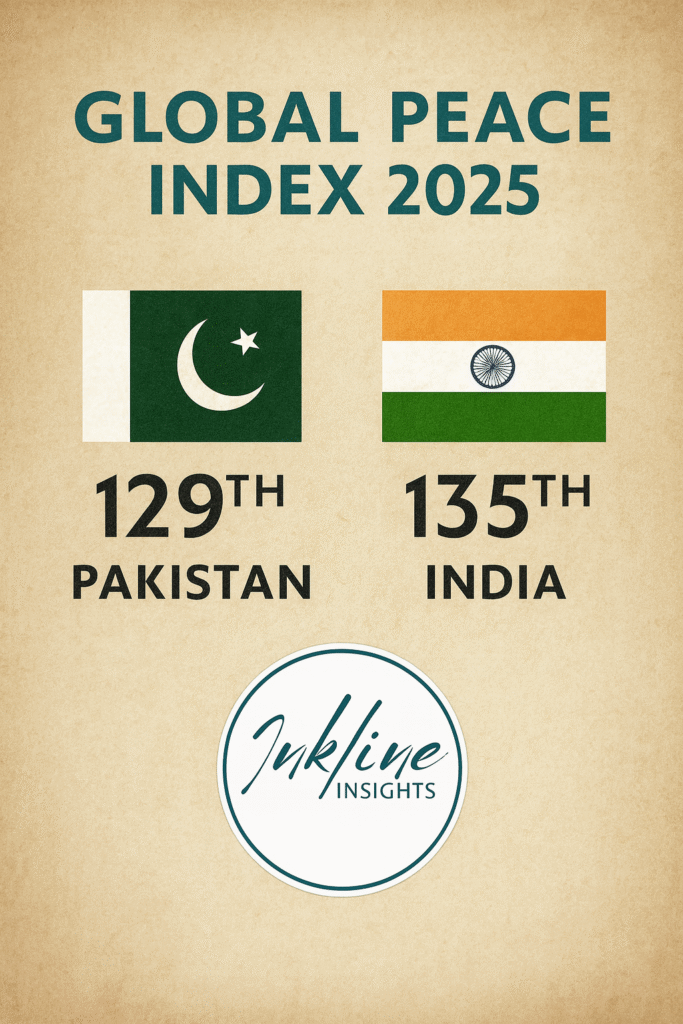
    The Global Peace Index 2025 reveals a widening gap in stability between Pakistan and India, highlighting how differently both countries are navigating regional security challenges. India ranks around the mid-tier globally at 115th, showing a slight improvement from the previous year. Its score reflects ongoing internal issues such as political tensions and localized unrest, but also acknowledges improvements in some security indicators. Pakistan, however, ranks much lower at 144th, placing it among the least peaceful nations, largely due to persistent security threats, economic instability, and border tensions that continue to impact its national outlook.

    Analysts note that India’s marginal rise in the rankings is partly tied to reduced conflict-related casualties and improvements in law-and-order assessments in some states. However, concerns remain over communal tensions, border skirmishes, and domestic political polarization, all of which influence the country’s overall peace score. Despite these challenges, India’s position is still significantly stronger than Pakistan’s, which continues to face a complex mix of internal security operations, militancy concerns, and economic pressures affecting state capacity.

    Pakistan’s decline reflects the growing strain on its internal stability, especially as economic hardship and rising political friction amplify security risks. Cross-border tensions with Afghanistan and India also play a major role, contributing to the country’s low ranking on the Index. Human rights groups and policy analysts emphasize that without a long-term plan to address militancy, political fragmentation, and economic vulnerabilities, Pakistan may continue to struggle in future global peace assessments.

    The 2025 report also warns that global peacefulness has deteriorated overall, making stability harder to maintain for many nations. In South Asia, the contrast between India’s steady but cautious progress and Pakistan’s ongoing challenges underscores the region’s broader volatility. As geopolitical tensions rise worldwide, the Index highlights the need for stronger governance, conflict reduction strategies, and regional cooperation to prevent further declines in peace and security.


  • Afghanistan Refugee Crisis Deepens in 2025 as Humanitarian Pressure Mounts on the Region

    The Afghan refugee crisis has deepened significantly in 2025, placing mounting humanitarian pressure on neighboring countries already grappling with economic and security challenges. A combination of persistent instability, limited economic opportunities, and ongoing restrictions under the Taliban government has pushed thousands of Afghans to seek safety and livelihoods across borders. Pakistan, Iran, and Central Asian states continue to receive the largest influx, straining their social services and resources. Camps and urban settlements are becoming overcrowded, with aid agencies warning that conditions are deteriorating as winter intensifies.

    International organizations report that funding gaps are widening, leaving millions of displaced Afghans without adequate access to food, healthcare, and shelter. Despite repeated appeals from the UN and humanitarian partners, global attention has shifted toward emerging crises elsewhere, reducing the flow of donor support. As a result, essential aid programs are being scaled back, forcing refugees to rely heavily on host communities that themselves face high inflation and unemployment. The shortage of medical supplies and educational facilities is particularly severe, putting vulnerable women and children at increased risk.

    Host countries are also tightening border controls and residency regulations in an attempt to manage the surge. Pakistan and Iran have both intensified documentation checks, while some provinces have initiated relocation drives to move undocumented Afghans away from major urban centers. These policies, though aimed at maintaining internal order, often lead to heightened fear and uncertainty among refugees, many of whom have lived in host nations for decades. Reports of deportations and forced returns have further raised concerns about the safety of those sent back to Afghanistan, where economic instability and limited services offer little support.

    Regional analysts caution that unless the global community renews its commitment to supporting both refugees and their host countries, the crisis may escalate further. Sustainable solutions require a combination of increased international funding, coordinated regional diplomacy, and long-term development programs inside Afghanistan to reduce the need for displacement. Without these measures, 2025 could mark yet another year where humanitarian pressures outpace available resources, leaving millions of Afghan families trapped in cycles of insecurity and uncertainty.

  • Green Packaging Innovations: Eco-Friendly Materials Shaping a Sustainable Future

    Green packaging is a game-changer for businesses looking to reduce their environmental footprint. It’s all about using eco-friendly materials and designs that minimize waste and pollution.

    Eco-Friendly Packaging Solutions

    • Recycled Materials: Use recycled paper, cardboard, or plastics to reduce waste.
    • Biodegradable Alternatives: Explore bioplastics, jute bags, or mushroom-based packaging.
    • Minimalist Designs: Simplify packaging to save resources and reduce costs.

    Benefits of Green Packaging

    • Reduce Greenhouse Gas Emissions: Sustainable packaging lowers carbon footprint.
    • Conserve Natural Resources: Eco-friendly materials and designs reduce waste.
    • Boost Brand Reputation: Customers love brands that care about the environment.

    Implementing Green Packaging

    • Assess Your Packaging: Identify areas for improvement.
    • Choose Sustainable Materials: Select eco-friendly materials that meet business needs.
    • Communicate with Customers: Share green packaging initiatives to build trust and loyalty.
  • Environment and Global Warming: Key Causes, Impacts, and Future Solutions

    Global warming has become one of the most urgent environmental challenges of the 21st century. As climate patterns shift and natural systems come under pressure, scientists warn that the window to prevent irreversible damage is closing rapidly. Today, rising temperatures, extreme weather, and declining ecosystems pose serious threats not only to the planet but also to human health, food security, and economic stability. Understanding the causes, impacts, and solutions to global warming is essential for governments, industries, and individuals who aim to build a sustainable future.

    What Is Global Warming?

    Global warming refers to the long-term increase in Earth’s average temperature primarily caused by the buildup of greenhouse gases—such as carbon dioxide, methane, and nitrous oxide—in the atmosphere. These gases trap heat, leading to the greenhouse effect, which intensifies as emissions continue to rise due to human activities

    Major Causes of Global Warming

    1. Burning of Fossil Fuels

    Power plants, transportation, and industrial activities are the largest contributors to carbon emissions. Countries dependent on coal and oil experience the highest rise in atmospheric pollution.

    1. Deforestation

    Forests act as natural carbon sinks. When millions of trees are cut down for farming, urbanization, and timber, CO₂ levels increase significantly.

    1. Industrial Production

    Factories release gases, chemicals, and pollutants that degrade air quality and contribute to global temperature rise.

    1. Agricultural Activities

    Livestock farming and large-scale agriculture release methane and nitrous oxide—two potent greenhouse gases.

    Current Facts & Figures (2025)

    Global temperatures are now 1.1°C higher than pre-industrial levels.

    The world must reduce emissions by 45% by 2030 to avoid crossing the 1.5°C temperature limit.

    More than 70% of natural disasters in recent years are linked to climate change.

    The past decade has been the warmest ever recorded in human history.

    These numbers highlight the critical need for immediate global action.

    Impacts of Global Warming on the Environment

    1. Extreme Weather Events

    Heatwaves, floods, wildfires, droughts, and powerful storms are becoming more frequent and intense.

    1. Melting Glaciers & Rising Sea Levels

    Ice loss in the Arctic and Antarctic has accelerated, increasing the risk of coastal flooding and loss of habitable land.

    1. Ocean Acidification

    Excess CO₂ is absorbed by oceans, harming coral reefs, marine species, and global fish populations.

    1. Loss of Biodiversity

    Thousands of plant and animal species are threatened due to changing habitats and rising temperatures.

    5. Impact on Human Health

    Air pollution, heat stress, and contaminated water lead to respiratory illnesses, dehydration, and the spread of infectious diseases.

    Solutions to Combat Global Warming

    1. Transition to Renewable Energy

    Solar, wind, hydropower, and other renewables can significantly cut carbon emissions and reduce dependency on fossil fuels.

    1. Reforestation & Afforestation

    Planting billions of trees worldwide restores ecosystems and improves carbon absorption.

    1. Sustainable Transportation

    Electric vehicles, public transport, and non-motorized mobility can greatly reduce urban emissions.

    1. Energy-Efficient Technologies

    Smart grids, green buildings, and low-energy appliances help lower consumption and environmental impact.

    1. Waste Reduction & Recycling

    Recycling materials, reducing single-use plastics, and promoting circular economy practices help protect ecosystems.

    1. Climate Education & Policy Support

    Strong government policies, carbon taxes, and environmental education encourage wider participation in climate action.

    Global Warming and Its Impact on Pakistan

    Pakistan is among the countries most vulnerable to climate change, facing severe floods, heatwaves, water scarcity, and glacial melt. The 2022 floods alone displaced millions of people and caused billions in damages—highlighting the urgent need for climate resilience. Rising temperatures also threaten agriculture, which employs a large portion of the population. Investments in clean energy, reforestation programs like the Billion Tree initiative, and improved water management systems are essential for Pakistan’s future sustainability.

    Conclusion: A Collective Responsibility

    Global warming is no longer a distant concern—it is a present reality affecting every continent and community. While the challenge is enormous, solutions are within reach if the world works together. By adopting renewable energy, protecting forests, implementing sustainable policies, and making eco-conscious choices, humanity can slow climate change and preserve the environment for future generations. The time for action is now, and every effort—big or small—brings us closer to a greener, safer planet.

  • Top Artificial Intelligence Trends in 2025: How AI Is Transforming Industries

    AI is an absolute game-changer, revolutionizing the way we live and work! 🤖💻 It’s like having a super-smart sidekick that can help us tackle complex problems, make life easier, and unlock new possibilities. With AI, we’re talking about intelligent systems that can learn, adapt, and improve over time, freeing us up to focus on the things that matter most.

    From healthcare to finance, education to transportation, AI is transforming industries left and right! 💸🏥 It’s bringing unprecedented levels of efficiency, accuracy, and personalization, making our lives more convenient, productive, and enjoyable.

    And let’s not forget about the economic impact AI is creating new opportunities, driving growth, and boosting competitiveness. It’s a no-brainer, really! 🚀 So, yeah, AI is pretty amazing, and we’re just scratching the surface of what’s possible!
    AI is revolutionizing Pakistan’s tech scene, transforming industries and driving growth. Artificial intelligence solutions are being adopted across various sectors, enhancing operations and improving customer experiences.

    AI in Pakistan:

    Businesses leverage AI to boost efficiency and productivity.
    Government initiatives support AI research and development.
    Tech hubs foster AI-driven startups and innovation.

    Key AI Applications:

    Virtual assistants simplify tasks and save time.
    Predictive analytics inform business decisions.
    Automation streamlines processes and reduces costs.

    As Pakistan’s AI sector grows, opportunities emerge in healthcare, finance, and e-commerce, driving economic growth and innovation.

  • The Biggest Problems With Roblox: Safety, Content, Spending, and Developer Concerns

    Roblox is a global platform where anyone can both play and create games, with a strong social element and a big creative community.

    Roblox was originally developed in 2004 by David Baszucki and Erik Cassel and officially launched to the public in 2006. As the platform grew into a massive hub for user-generated games, various issues began surfacing. Early concerns included scams, misleading in-game purchases, and inconsistent content quality. As Roblox’s audience—especially children—expanded, more serious criticisms emerged around safety, moderation gaps, inappropriate content, and the pressure of Robux spending. Over time, developers also raised concerns about revenue cuts and support limitations. These ongoing issues have become more visible as Roblox continues to grow in popularity.

    Roblox gets a lot of love, but it’s not without its issues. Here are some of the criticisms:

    Safety’s a big concern – kids can stumble upon inappropriate content or get harassed. The virtual currency system can be confusing, and it’s easy to overspend. With so many user-made games, quality’s hit or miss – some are buggy or just not that fun.

    Parents might struggle to control what their kids are playing, and let’s be real, it’s easy to get sucked in and spend hours playing. Some creators have issues with copyright infringement and getting their work stolen.

    Devs aren’t always happy either – they feel like Roblox takes too big a cut of their earnings, and support can be lacking when they need help.

    In-app purchases can get pricey, and it’s not always clear how Roblox moderates content or decides what stays up. These are all things Roblox could work on to make the platform better for everyone.

  • Hayli Gubbi Volcano Eruption Disrupts Asian Flights: Pakistan Issues Volcanic Ash Advisory

    On Sunday 23 November 2025 at 10:00 am the eruption of Hayli Gubbi volcano in Ethiopia’s Afar region sent shockwaves across the aviation industry, disrupting air travel across Asia, including Pakistan. This unexpected event caught many off guard, as the volcano had been dormant for thousands of years, its fiery potential long forgotten. As the ash plume rose high into the atmosphere, airlines scrambled to adjust their routes, cancelling flights and rerouting planes to avoid the affected areas.

    The Pakistan Meteorological Department sprang into action, issuing timely Volcanic Ash Advisories to alert airlines and passengers of the potential risks. Thankfully, the country’s airspace is now clear, and aviation has resumed normal operations. The swift response of authorities ensured that disruptions were minimal, and there were no reported risks to public health or environment in Pakistan.

  • 2025–26 Global Sports Calendar: Key International Events Fans Should Track

    The 2025–26 global sports calendar is set to be one of the most action-packed seasons in recent memory, with major international tournaments, world championships, and continental competitions scheduled across nearly every sporting discipline. For fans, athletes, and analysts alike, the upcoming cycle promises a vibrant mix of high-stakes rivalries, emerging talent, and record-breaking performances.

    Football Takes Center StageFootball remains the biggest global attraction, with the 2026 FIFA World Cup qualifiers intensifying throughout 2025. Several regional confederations will host crucial qualification rounds, making next season essential for teams looking to secure early momentum. In addition, the UEFA Champions League, Copa Libertadores, and AFC Champions League will run parallel to domestic leagues, ensuring a year filled with elite club competitions.Olympic Sports Build Toward 2028With the Los Angeles 2028 Olympics approaching, many sports will use the 2025–26 season as a key qualification and ranking period. Athletics, swimming, gymnastics, and cycling will feature heavily contested world championships, where athletes aim to secure ranking points and benchmark their performance ahead of the next Olympic cycle.

    Cricket, Tennis & Motorsport Expand Their Global FootprintCricket fans can expect a busy year with several marquee events, including ICC world tournaments and high-profile bilateral series. Meanwhile, tennis will continue to dominate headlines with the four Grand Slams — Australian Open, Roland-Garros, Wimbledon, and US Open — expected to feature rising stars alongside seasoned champions.Motorsport enthusiasts will witness full calendars for Formula 1, MotoGP, and Formula E, each introducing new circuits and technological innovations that promise heightened competition. F1 in particular is anticipated to deliver a dramatic season as teams refine next-generation car designs under updated regulations.

    Combat Sports and Emerging Disciplines Gain MomentumCombat sports — including boxing, MMA, and judo — will also have peak seasons, with several championship bouts and Olympic qualification events on the horizon. Newer sports such as eSports and competitive climbing continue to build global audiences, contributing to a diverse and modernized sports landscape.A Season Defined by Global EnergyFrom packed stadiums in Europe to electric crowds in Asia, the 2025–26 sports year will showcase the breadth of international athletic excellence. With major tournaments distributed across multiple continents, fans will have no shortage of must-watch events, making the upcoming cycle one of the most anticipated in years.

    Whether you’re a casual follower or a dedicated sports enthusiast, the upcoming global sports season offers a compelling mix of tradition, innovation, and world-class competition — ensuring that 2025–26 will be remembered as a landmark chapter in in

  • North Korea and Russia Strengthen Relations Through Major Sports Exchanges

    North Korea and Russia are deepening their diplomatic partnership through a series of large-scale sports exchanges, marking one of the most active phases of cooperation between the two nations in recent years. While political and economic ties have long shaped their relationship, both countries are now turning to the sports sector as a strategic tool to strengthen cultural connections and enhance people-to-people engagement.

    Over the past year, delegations of athletes, coaches, and sports officials have traveled between Pyongyang and Moscow to participate in friendly matches, joint training camps, and multi-disciplinary tournaments. These exchanges span a range of popular sports — including football, judo, gymnastics, and weightlifting — areas where both nations hold historic competitive strength.

    Officials from both sides have emphasized that expanding sports collaboration is not just symbolic. For Russia, which has faced increasing isolation from several international sports bodies, partnerships with nations like North Korea provide an alternative platform to maintain competitive opportunities. For North Korea, the cooperation aligns with its long-standing goal of strengthening international visibility while providing its athletes with exposure to new training environments and expertise.

    Beyond athletic development, these exchanges are also being framed as an important diplomatic gesture. Sports diplomacy has frequently served as a softer, less politically charged channel for nations to build trust. Analysts note that these initiatives may pave the way for broader collaboration across culture, tourism, and education.

    Additionally, discussions are reportedly underway to establish recurring tournaments hosted alternately by the two countries, as well as integrated youth-sports development programs. These initiatives could further solidify their partnership while offering regular opportunities for cross-cultural engagement.

    As geopolitical tensions continue to reshape global alliances, the North Korea–Russia sports corridor signals a growing willingness between the two nations to diversify their cooperation beyond traditional political and military domains. The expanding role of sports in their bilateral relationship highlights how athletic exchange remains a powerful tool of diplomacy — capable of forging connections even amid broader global uncertainty.