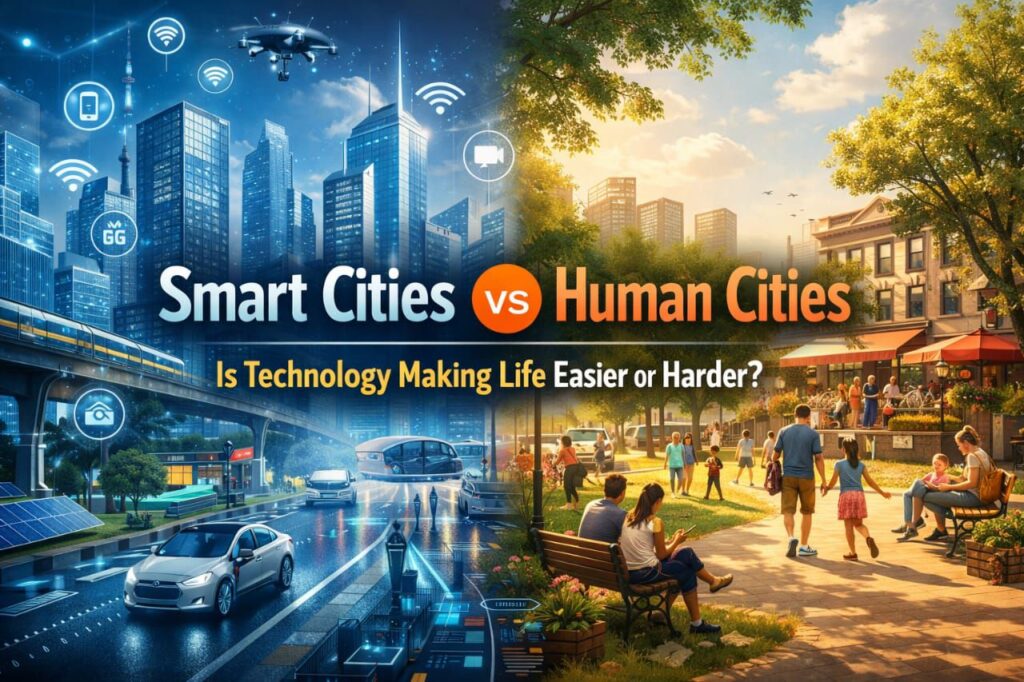
As the world rapidly urbanizes, cities are evolving faster than ever before. Governments and planners are increasingly turning toward technology-driven solutions, commonly known as smart cities, to manage growing populations and limited resources. At the same time, many experts argue that cities should remain human-centric, focusing on social well-being, culture, and community values rather than heavy automation.This debate raises a crucial question: Is technology truly making urban life easier, or is it creating new challenges for people?
What Is a Smart City?
A smart city uses digital technologies, data, and automation to improve urban services and infrastructure. These cities rely on tools such as sensors, artificial intelligence, cloud systems, and connected devices to manage traffic, energy, security, waste, and public services more efficiently.
The main goal of smart cities is to optimize resources, reduce costs, and improve quality of life by making real-time decisions based on data. Examples include intelligent traffic lights, smart electricity meters, online government services, and automated surveillance systems.
Global Growth of Smart Cities
According to global urban development studies, over 55% of the world’s population currently lives in cities, and this figure is expected to reach nearly 70% by 2050. To cope with this growth, governments are investing heavily in smart city initiatives.
Countries across Asia, Europe, and the Middle East are implementing digital infrastructure projects worth billions of dollars. Cities like Singapore, Barcelona, Dubai, and Seoul are often cited as leading examples due to their use of technology in transportation, governance, and sustainability.
This rapid expansion shows that smart cities are no longer a concept of the future—they are already shaping modern urban life.
How Smart Cities Make Life Easier
1. Efficient Transportation and Mobility
One of the biggest advantages of smart cities is improved traffic management. Smart traffic signals and GPS-based systems help reduce congestion, saving time and fuel. Digital public transport systems allow citizens to track buses and trains in real time, improving daily commuting experiences.
These systems also help reduce air pollution by minimizing idle traffic and encouraging the use of public transport.
2. Better Energy and Resource Management
Smart cities use intelligent energy grids and water systems to reduce waste and improve efficiency. Smart meters allow households to monitor electricity usage, helping people lower utility bills.
Studies suggest that smart energy systems can reduce electricity consumption by 20–30%, which benefits both the environment and city budgets.
3. Improved Public Safety and Services
Technology-enabled monitoring systems help cities respond faster to emergencies. Smart surveillance, emergency alerts, and digital reporting tools support law enforcement and disaster management agencies.
Additionally, e-government platforms allow citizens to pay bills, file complaints, and access public services online, saving time and reducing bureaucracy.
4. Environmental Sustainability
Smart cities promote sustainability by using data to control pollution levels, manage waste collection, and support renewable energy projects. Smart waste bins, for example, notify authorities when they are full, reducing unnecessary collection trips and fuel consumption.
This data-driven approach helps cities become cleaner, greener, and more climate-resilient.
When Technology Makes Urban Life Harder
Despite their benefits, smart cities also present several challenges that cannot be ignored.
1. Privacy and Data Security Concerns
Smart cities collect large amounts of data through cameras, sensors, and online platforms. While this data improves services, it also raises concerns about privacy and surveillance.
If not properly regulated, data misuse or cyberattacks could threaten personal information and public trust.
2. High Costs and Financial Pressure
Building and maintaining smart infrastructure requires significant investment. Developing countries and smaller cities may struggle with funding, maintenance, and system upgrades.
These high costs can divert funds from essential services like healthcare, housing, and education.
3. Digital Divide and Social Inequality
Not everyone benefits equally from smart city technologies. People without internet access, digital skills, or smart devices may feel excluded from essential services.
This digital divide can increase social inequality if technology adoption is not inclusive and accessible for all citizens.
4. Over-Dependence on Technology
As cities become more automated, even minor technical failures can disrupt essential services. Power outages, software errors, or cyber issues may affect transportation, utilities, or communication systems.
This over-reliance on technology can reduce human flexibility and resilience during unexpected situations.
What Are Human Cities?
Human cities focus on people rather than systems. These cities prioritize community interaction, cultural identity, walkable neighborhoods, and social well-being. Instead of relying heavily on automation, human cities emphasize public spaces, local economies, and face-to-face engagement.
Human-centric planning encourages accessible public parks and streets, strong community networks, local businesses and cultural heritage, and inclusive urban design.
These elements help create emotional connections and social trust within communities.
Smart Cities vs Human Cities: Finding the Balance
The future of urban living does not lie in choosing one approach over the other. The most successful cities combine smart technology with human values.
Technology should support people, not replace them. Cities that balance efficiency with empathy tend to perform better in terms of happiness, sustainability, and long-term growth.
Urban planners now promote people-first smart cities, where innovation improves daily life while protecting privacy, inclusion, and social harmony.
Conclusion
Smart cities offer powerful tools to manage modern urban challenges, from traffic congestion to energy shortages. However, technology alone cannot solve every problem. Without careful planning, it can increase inequality, reduce privacy, and weaken social connections.
Human cities remind us that cities are not just systems—they are homes for people. The ideal future lies in blending smart solutions with human-centered design.
When technology is used responsibly and inclusively, it can truly make city life easier, not harder.
Leave a Reply