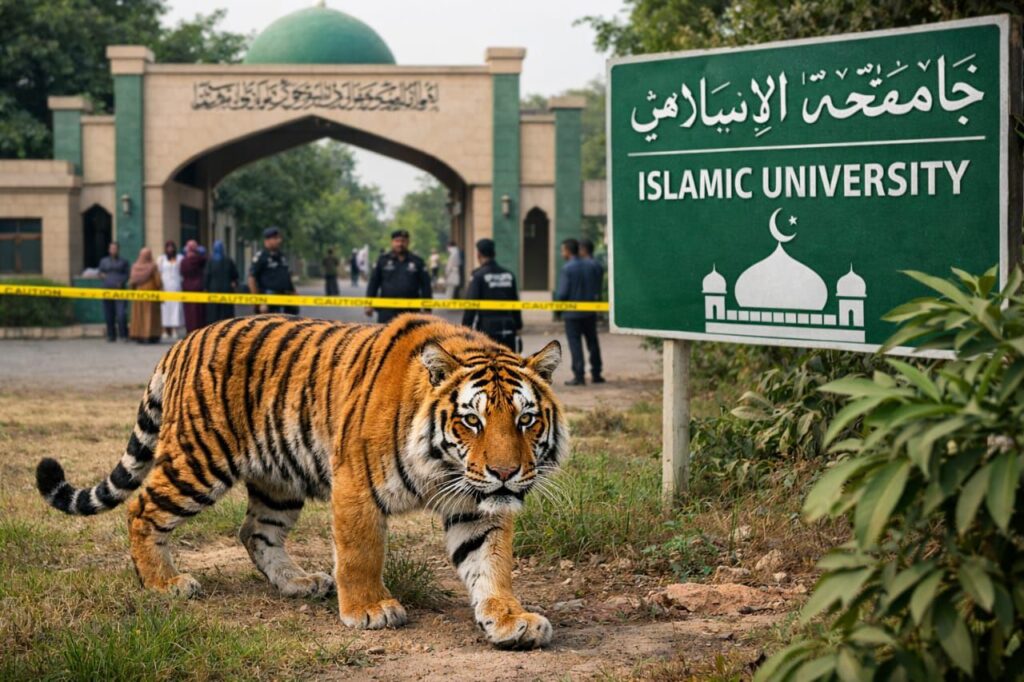
Incidents involving wildlife entering urban or educational spaces are becoming increasingly visible across South Asia. Recently, news about a tiger reportedly reaching an Islamic university campus gained widespread attention on social media and local platforms. While such reports can sometimes be exaggerated, they open an important discussion on wildlife conservation, campus safety, and the responsibility of institutions located near natural habitats.
Understanding the Reported Incident
According to initial reports, a large wild animal believed to be a tiger was seen near or around the boundaries of an Islamic university. The sighting caused understandable concern among students, faculty, and nearby residents. University officials reportedly coordinated with wildlife and law enforcement authorities to evaluate the situation and restrict access to sensitive areas temporarily.
Importantly, no confirmed injuries or damage were reported. Authorities advised calm, emphasizing that quick action and clear communication are critical in such situations.
Are Tiger Sightings Near Cities Possible?
Yes, though rare, tiger sightings near human settlements are scientifically documented. According to wildlife conservation studies:
Tigers can travel 20–30 kilometers in search of food or territory.
Habitat loss has reduced forest cover in South Asia by nearly 30% over the last 50 years.
Expansion of cities near forests increases human-wildlife encounters.
In Pakistan and neighboring regions, wildlife corridors often overlap with expanding urban areas, making occasional animal movement more likely.
Why Would a Tiger Approach an Educational Institution?
Several factors may contribute:
-Habitat Encroachment
-Deforestation and construction push wildlife out of natural environments.
-Food Scarcity
-Reduced prey availability forces animals to roam farther.
-Seasonal Migration Patterns
-Animals may follow natural water or prey routes.
-Misinformation or Misidentification
In some cases, animals such as leopards are mistakenly identified as tigers, leading to confusion.
Campus Safety Measures Taken
Educational institutions follow standard emergency protocols when wildlife threats are suspected:
Immediate restriction of student movement
Coordination with wildlife and forest departments
Use of trained response teams, not civilians
Clear announcements to prevent panic
Such responsible actions help maintain safety while respecting wildlife laws.
Islamic Perspective on Wildlife Protection
From an Islamic viewpoint, compassion toward animals is a well-established principle. Islamic teachings emphasize:
Animals are part of Allah’s creation
Harm should not be inflicted without necessity.
Humans are caretakers (Khalifah) of the Earth
Universities rooted in Islamic values often integrate environmental ethics into their policies, promoting coexistence rather than conflict.
Facts & Figures on Human-Wildlife Conflict
According to environmental organizations, over 70% of wildlife conflicts occur near forest borders.
Proper fencing and awareness reduce incidents by up to 60%.
Early warning systems lower panic-related injuries significantly.
These figures show that preparedness, not fear, is the solution.
Role of Media and Social Platforms
While awareness is important, sensational headlines can cause unnecessary panic. Responsible reporting should focus on:
-Verified information
-Official statements
-Public safety guidance
Lessons for Universities and Urban Planners
This incident offers key takeaways:
-Campuses near natural zones should conduct regular safety audits
-Wildlife awareness programs help students respond calmly
-Collaboration with environmental departments is essential
-Infrastructure planning must consider ecological boundaries
Conclusion
The reported tiger sighting at an Islamic university serves as a reminder of the delicate balance between urban development and wildlife conservation. While such events can be alarming, they also present an opportunity to strengthen safety systems, environmental education, and ethical responsibility.
By responding calmly, relying on verified facts, and respecting nature, educational institutions can protect both human life and wildlife. Responsible awareness—not fear—is the path forward.
Leave a Reply