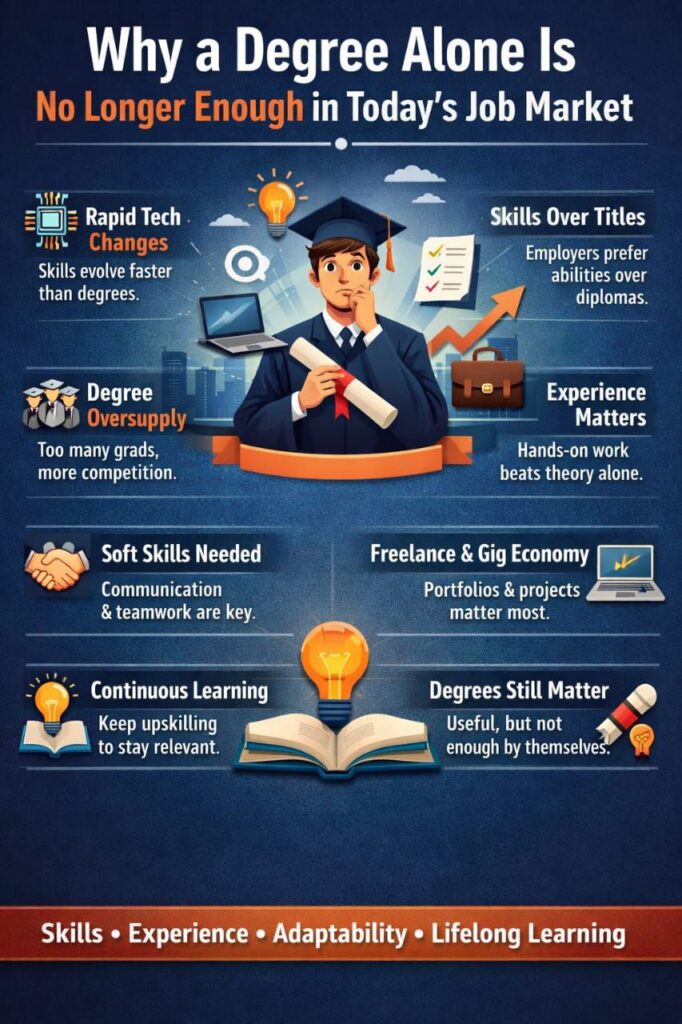
In the past, earning a college or university degree was considered a guaranteed path to success. A degree symbolized knowledge, credibility, and a strong chance of landing a well-paying job. However, in 2026, this belief is rapidly changing. While higher education still holds value, a degree alone is no longer enough to secure long-term career growth or financial stability. Rapid technological advancement, changing employer expectations, and global competition have reshaped the job market in ways that demand far more than academic certificates.
This article explains why a degree by itself is no longer sufficient, supported by facts, figures, and real-world trends, and highlights what truly matters for success today.
1. Rapid Technological Change Has Redefined Skills
One of the biggest reasons degrees are losing standalone value is the speed of technological change. According to the World Economic Forum, nearly 44% of workers’ skills will be disrupted by technology by 2027. Fields like artificial intelligence (AI), data analytics, cloud computing, and automation evolve faster than traditional university curricula.
Most degree programs take four years to complete, while technology can change significantly within a single year. As a result, graduates often enter the job market with outdated technical knowledge. Employers now prioritize candidates who continuously update their skills through short courses, certifications, and hands-on projects rather than relying solely on what they learned in university.
2. Employers Value Skills More Than Titles
Modern employers are shifting toward a skills-based hiring approach. A 2024 LinkedIn Workplace Learning Report revealed that over 75% of recruiters focus more on practical skills than formal education when shortlisting candidates. This is especially true in industries such as IT, digital marketing, design, and freelancing.
For example, a company hiring a digital marketer is more interested in proven results—such as managing ad campaigns, improving website traffic, or increasing conversions—than just a marketing degree. Similarly, software companies often test coding skills directly instead of relying on academic transcripts.
Degrees show theoretical understanding, but skills demonstrate the ability to perform real tasks. In competitive markets, performance matters more than paper qualifications.
3. Oversupply of Degree Holders Has Increased Competition
Over the last two decades, access to higher education has expanded globally. According to UNESCO, the number of students enrolled in higher education worldwide crossed 235 million, compared to about 100 million in the early 2000s. While this is positive for education access, it has also created an oversupply of degree holders.
When thousands of applicants hold similar degrees, employers need additional criteria to differentiate candidates. Internships, portfolios, freelance experience, communication skills, and problem-solving abilities often become deciding factors. A degree may get a resume noticed, but it rarely guarantees selection anymore.
4. Practical Experience Matters More Than Theory
Many graduates struggle because they lack practical experience. Academic programs often focus heavily on theory, exams, and grades, while real-world jobs require decision-making, teamwork, and adaptability.
A survey by the National Association of Colleges and Employers (NACE) found that over 60% of employers prefer candidates with relevant work experience, even for entry-level roles. Internships, part-time jobs, remote work, and freelancing help bridge the gap between education and employment.
In contrast, candidates with only a degree and no experience may require extensive training, which increases costs for employers. This makes experienced candidates more attractive, even if they do not hold advanced degrees.
5. Soft Skills Are Now Critical for Career Growth
Another major limitation of degrees is that they rarely develop soft skills effectively. Skills such as communication, leadership, emotional intelligence, adaptability, and teamwork are essential in modern workplaces.
Research by Google’s Project Oxygen showed that top-performing employees excelled in soft skills more than technical expertise. Employees who can communicate clearly, manage time, handle feedback, and work in diverse teams are more likely to succeed and be promoted.
Degrees may teach subject knowledge, but soft skills are usually developed through real-life interactions, workplace challenges, and continuous self-improvement.
6. Rise of Freelancing and the Gig Economy
The global job market has also shifted toward freelancing and remote work. According to Statista, the global freelance workforce is expected to exceed 1.5 billion people by 2030. In freelancing platforms, clients rarely ask for degrees. Instead, they look for portfolios, reviews, and proven results.
For example, content writers, graphic designers, video editors, and virtual assistants are hired based on samples and performance. A degree may add credibility, but it does not replace skill mastery or client satisfaction.
This trend shows that income opportunities are increasingly linked to what you can do, not what certificate you hold.
7. Continuous Learning Is the New Standard
In 2026, learning is no longer a one-time phase; it is a lifelong process. Short online courses, professional certifications, and self-learning platforms allow people to acquire in-demand skills quickly and affordably.
Platforms offering courses in AI, SEO, cybersecurity, and data science often update content annually, unlike traditional degree programs. Professionals who commit to continuous learning stay relevant, while those relying only on past education risk becoming obsolete.
8. Degrees Still Matter—But Not Alone
It is important to clarify that degrees are not useless. They still provide foundational knowledge, discipline, and credibility, especially in fields like medicine, engineering, law, and education. However, their role has changed.
Today, a degree works best when combined with:
Practical skills
Real-world experience
Soft skills development
Continuous learning
Strong professional networking
This combination creates a well-rounded professional profile that meets modern employer expectations.
Conclusion
In today’s fast-changing world, a degree alone is no longer enough to guarantee success. Technological disruption, skills-based hiring, increased competition, and the rise of freelancing have transformed how careers are built. Employers now seek adaptable individuals who can apply knowledge, solve problems, and keep learning.
For students and professionals alike, the message is clear: education is just the starting point. True success comes from combining academic learning with practical skills, experience, and a mindset of continuous growth. Those who understand this shift will not only survive but thrive in the evolving job market of 2026 and beyond.
Leave a Reply