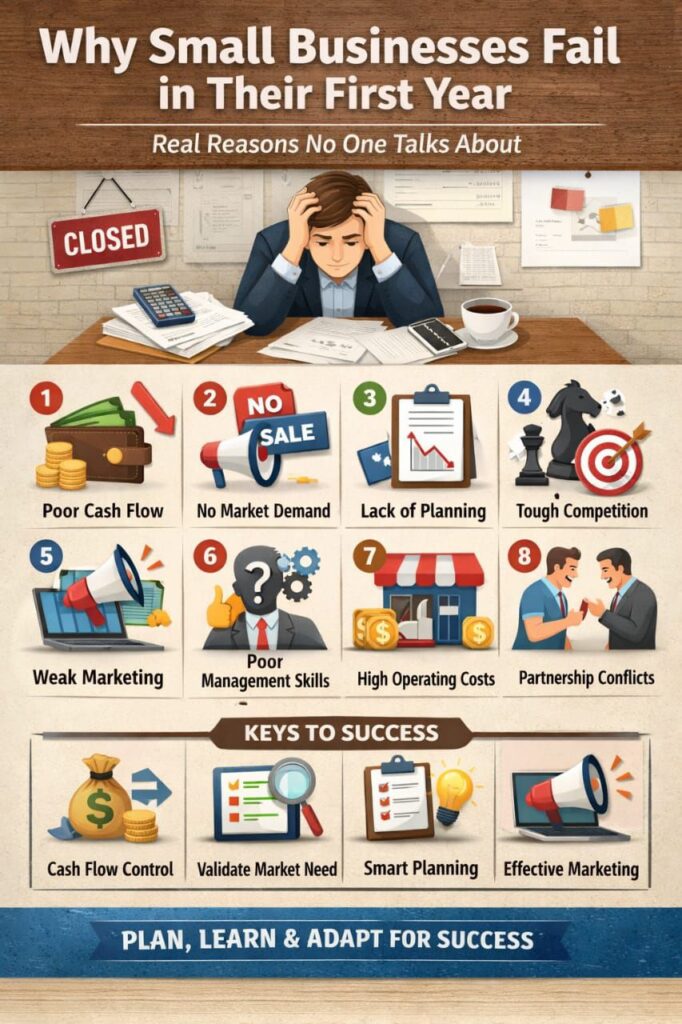
Starting a small business is often described as a path to independence and financial freedom. Every year, millions of entrepreneurs launch new ventures with high hopes and ambitious plans. However, the reality is far more challenging. Global business data consistently shows that around 20% of small businesses fail within their first year, and many more struggle to survive beyond that point.
While failure is often blamed on “bad luck” or “lack of effort,” the real reasons are deeper, more practical, and rarely discussed openly. Understanding these hidden factors can help new entrepreneurs avoid common mistakes and improve their chances of long-term success.
This article explores the real, data-based reasons small businesses fail in their first year, written in a clear, AdSense-safe, and SEO-friendly manner.
1. Poor Cash Flow Management (Not Lack of Profit)
One of the most misunderstood reasons for early business failure is cash flow. Many businesses close not because they are unprofitable, but because they run out of usable cash.
Common cash flow problems include:
- Underestimating startup and operating costs
- Spending too much too early
- Delayed customer payments
- No emergency financial buffer
New entrepreneurs often assume that sales automatically mean stability. In reality, if expenses must be paid before revenue arrives, the business can collapse quickly.
Key insight: A business can show profits on paper and still fail due to poor cash flow timing.
2. No Proven Market Demand
Another major but rarely admitted reason is starting a business without real market demand. Many founders fall in love with their idea without confirming whether enough people are willing to pay for it.
This usually happens when:
- Market research is skipped or rushed
- Decisions are based on assumptions, not data
- The target audience is too small or unclear
- Customer pain points are misunderstood
Even well-designed products fail if they do not solve a real problem or offer clear value.
3. Weak or Unrealistic Business Planning
Some entrepreneurs believe that business plans are unnecessary or outdated. However, a lack of structured planning significantly increases failure risk.
Poor planning often leads to:
- Overestimated revenue expectations
- Underestimated expenses
- No clear growth strategy
- No risk management or backup plans
A strong business plan helps owners make informed decisions, manage resources efficiently, and respond to challenges with clarity.
4. Inability to Compete in Saturated Markets
Many small businesses enter industries that are already crowded. Without a clear competitive advantage, survival becomes difficult.
Common mistakes include:
- Offering the same products as competitors with no differentiation
- Competing only on price, which reduces profit margins
- Ignoring branding and customer experience
To survive, a business must clearly communicate why it is different and why customers should choose it.
5. Poor Marketing and Low Online Visibility
In today’s digital economy, visibility is critical. Businesses that fail to market themselves effectively often struggle to attract customers, even if their product is good.
Marketing-related failure reasons include:
- No clear marketing strategy
- Weak social media presence
- Ignoring SEO and search visibility
- Inconsistent messaging
Many small businesses rely only on word-of-mouth, which is rarely enough during the first year.
6. Lack of Business and Management Skills
Passion alone is not enough to run a successful business. Many founders are skilled in their product or service but lack essential management knowledge.
This gap shows up in:
- Poor decision-making
- Inefficient operations
- Weak customer service
- Inability to manage staff or suppliers
Successful entrepreneurs continuously learn about finance, leadership, and operations—not just sales.
7. High Operating Costs and Poor Cost Control
Rent, utilities, salaries, logistics, and software subscriptions can quickly drain resources. Businesses that fail to control costs during the first year often face unsustainable financial pressure.
Common cost-related issues:
- Choosing expensive locations too early
- Hiring more staff than necessary
- Ignoring small recurring expenses
Cost discipline during the early stages significantly improves survival chances.
8. Partnership Conflicts and Internal Issues
Many businesses fail due to internal disagreements rather than external factors. Conflicts between partners, unclear roles, or mismatched expectations can slow decision-making and damage trust.
Typical problems include:
- No written agreements
- Disagreements over money or control
- Poor communication
Clear roles, transparency, and documentation are essential from the beginning.
9. External Economic and Market Changes
Economic uncertainty, inflation, policy changes, and shifting consumer behavior can affect even well-run businesses. While these factors are often beyond control, poor preparation makes their impact worse.
Businesses that lack flexibility, savings, or alternative strategies are more vulnerable during economic fluctuations.
10. Emotional Burnout and Unrealistic Expectations
Running a small business is mentally demanding. Long hours, stress, and slow progress can lead to burnout, especially during the first year.
Many entrepreneurs quit because:
- Results take longer than expected
- Stress affects motivation and decision-making
- There is no support system or guidance
Mental resilience and realistic expectations are just as important as financial planning.
Conclusion: Failure Is Often Preventable
Small business failure in the first year is rarely caused by a single mistake. It is usually the result of multiple avoidable issues—poor planning, weak cash flow control, lack of market research, and ineffective marketing.
Key Takeaways for First-Year Survival
✔ Manage cash flow carefully
✔ Validate market demand before scaling
✔ Plan realistically
✔ Control costs
✔ Invest in marketing and visibility
✔ Keep learning and adapting
Understanding these real reasons gives entrepreneurs a stronger foundation to build sustainable, ethical, and profitable businesses that align with modern digital standards.
Leave a Reply