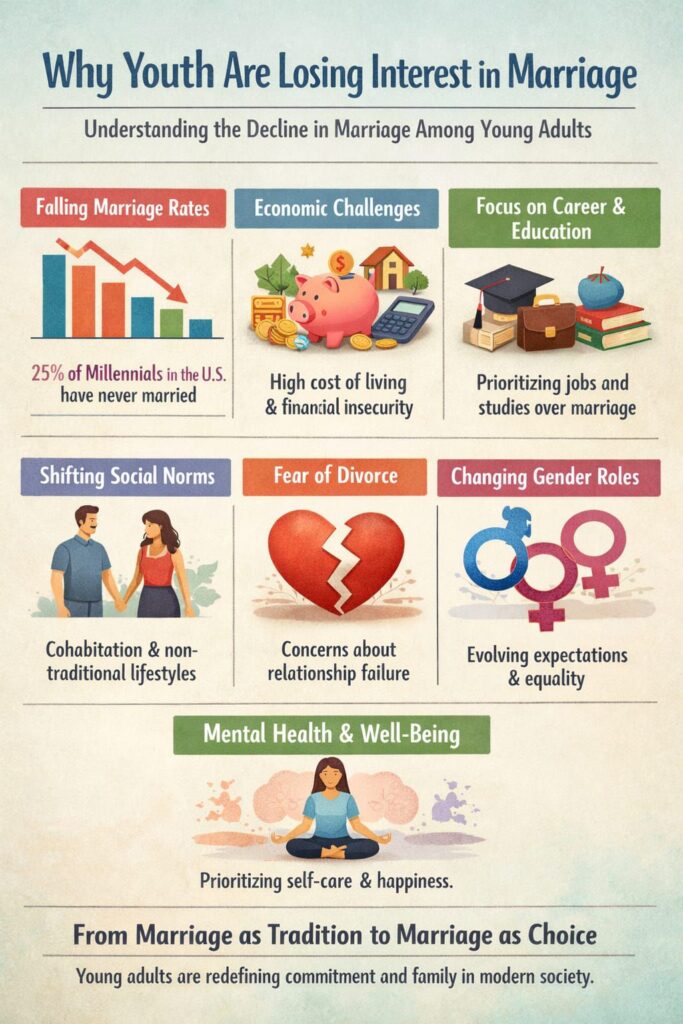
Marriage has long been considered a cornerstone of adulthood across cultures — a transition into stability, family life, and social recognition. However, in recent decades, this view has shifted dramatically. Around the world, young people are marrying later or not at all, and this change is reshaping societies, economies, and even future demographics. In this article, we explore why youth are losing interest in marriage, backed by statistics, global trends, and cultural insights.
1. A Clear Trend: Marriage Rates Are Falling Worldwide
Marriage rates have been declining for years, particularly among Millennials (born ~1981–1996) and Gen Z (born ~1997–2012). Research shows that:
- 25% of 40-year-old Millennials in the U.S. have never married, a record high and far above past generations.
- In the United States, the median age of first marriage has risen to nearly 29.8 for men and 28.4 for women — significantly older than a few decades ago.
- Among high school seniors, only about 61% of girls now say they want to get married someday, down from 83% in 1993.
Globally, countries like China have witnessed dramatic declines in marital registrations — about 20% fewer marriages in 2024 compared with 2023, the lowest in decades.
These trends indicate not just delayed marriage, but a shift in how young adults perceive marriage’s importance in life.
2. Economic Pressures & Financial Instability
One of the strongest reasons youth delay or avoid marriage is money.
Rising Costs of Living and Financial Insecurity
- High housing prices, stagnant wages, and job market uncertainty make setting up a household difficult for many young adults.
- Weddings themselves can be expensive — in some countries, costs can reach tens of thousands of dollars, making marriage feel like a financial luxury.
- Young people often prioritize financial stability (secure job, saving for housing) before marriage, which delays family formation.
For many, marriage is no longer a milestone but a financial risk, especially in economies with high unemployment or inflation.
3. Career, Education and Personal Development
Young adults today are more focused on education and career goals than prior generations.
- With widespread access to higher education, many delay marriage until after postgraduate studies or stable employment.
- Professional aspirations often mean putting social milestones — including marriage and children — on hold.
This shift is especially true among women, whose participation in higher education and the workforce has increased sharply in recent decades, giving them greater autonomy and life choices.
In many cultures, this change reflects a broader emphasis on self-actualization, skill development, and individual identity before committing to lifelong partnership.
4. Changing Social Norms & Cultural Values
Marriage used to be viewed as a necessary rite of passage. Today, that assumption is weakening.
- Couples are increasingly choosing cohabitation without marriage, viewing it as equally legitimate.
- Non-traditional relationships, including long-term partnerships without legal ties, are now socially acceptable in many regions.
- Social media and globalized culture expose youth to diverse lifestyles where independence and personal choice are emphasized.
This cultural shift is part of a broader acceptance of alternative life paths — travel, entrepreneurship, creative pursuits — which don’t always involve marriage.
5. Gender Roles, Expectations & Perceptions
Expectations around marriage roles — within family, economy, and gender — continue to evolve.
- Historical stereotypes about marriage being “necessary for women” are fading as women gain financial independence.
- Research highlights that young women today are less inclined to view marriage as essential compared to even a generation ago.
- Meanwhile, pressures on men to be financially established before marriage can create mismatches in readiness and expectations.
These trends reflect broader societal conversations about gender equity, partnership dynamics, and emotional fulfillment vs. tradition.
6. Fear of Divorce and Relationship Fragility
Divorce rates — particularly in urban and developed societies — have influenced young people’s perspective on marriage.
- Many youth witness divorce in families or social circles, leading to uncertainty about long-term commitment.
- Marriage is often seen as a risk rather than a guarantee of happiness.
This fear of relationship breakdown motivates some to favor flexible arrangements over legal or traditional marriage.
7. Mental Health, Individual Well-Being & Priorities
Today’s youth often prioritize mental health, well‐being, and personal growth over conventional milestones.
- Large numbers report that emotional health and self-discovery are core goals in early adulthood.
- Many view marriage as potentially restrictive or stressful rather than inherently fulfilling.
This trend shows how self-care and personal satisfaction have become central drivers of life decisions.
Conclusion: Marriage Is Not Dead — It’s Evolving
The idea that young people are “losing interest in marriage” can be misleading. Rather than rejecting love or partnership entirely, many are redefining what commitment and family mean in the modern world.
Marriage rates are declining or delayed due to economic realities, educational priorities, cultural shifts, and changes in personal values. Young adults today seek financial stability, personal fulfillment, emotional intelligence, and flexible life planning.
This transformation doesn’t signal the end of marriage as an institution, but its evolution — from a default life stage to a deliberate choice shaped by contemporary realities.
Leave a Reply